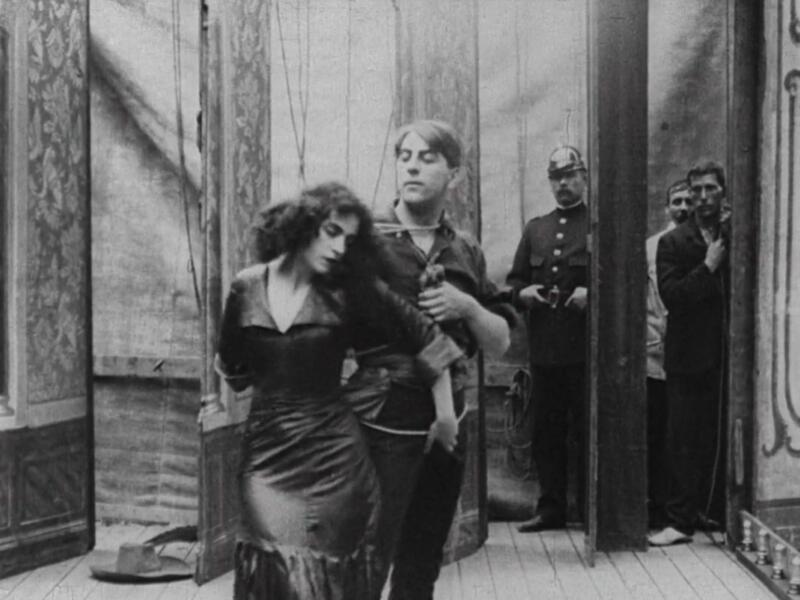
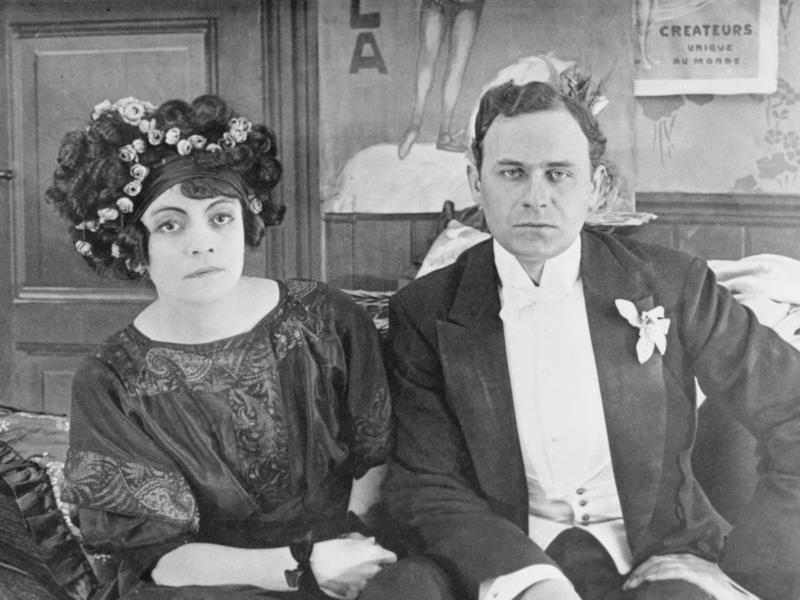
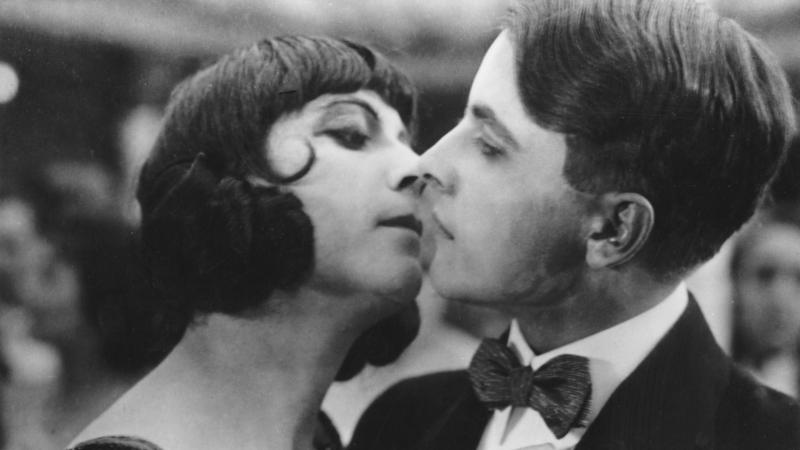
Danish actress Asta Nielsen (1881-1972) became famous with her first film role in the silent film Afgrunden (The Abyss, 1910), which turned out to be especially successful in Germany. The screenplay was written by Urban Gad (1879-1947) who also directed the film. Gad worked exclusively with Nielsen as leading actress on 31 German productions, until the outbreak of World War I. The prima donna roles in Gad’s films were written exclusively for Nielsen and consolidated her fame. In 1914, German film critic Horst Emscher wrote:
Asta Nielsen’s great artistic talent would surely have made its mark in the world of cinema (…) but whether she would have achieved what she did with Urban Gad’s loyal collaboration is a matter of reasonable doubt. (…) The director Urban Gad, however, deserves the highest praise – even his colleagues acknowledge this – and only those in the know can truly appreciate what that means (Emscher 1914).1
Emscher described Gad as a “master director” with “great natural talent” and as “sole ruler of the large ‘PAGU’ studio.”2 Additionally, he praised Nielsen’s and Gad’s collaboration as admirable and as an alliance “that will find a lasting place in the history of cinematic art” (Emscher 1914). Emscher’s article was also accompanied by a large photo of Gad at his desk.
First Page of Article by Emscher, Horst (1914). "Urban Gad als Regisseur", Deutsche Kino Rundschau, Nr. 26/27, S.1.
Today, Nielsen is seen as the biggest icon of German silent film, while references to Gad are scarce. He is mainly mentioned in publications about and by Nielsen.
Gad’s obscurity seems peculiar, given that belief in a director's decisive artistic influence on the outcome of a film project has been widely held since the rise of auteur theory in the 1950s.3 It manifests itself, for example, in German copyright law and retrospective screenings that showcase a director’s oeuvre. In Germany, the term “Autorenfilm” already existed during Gad’s career. However, back then it was used to describe literary adaptations, in which the author of the original book wrote the screenplay. Since film still had to prove itself as an art form, screenwriters were generally held in higher regard than directors – and Gad himself subscribed to this view. In his filmmaking treatise Filmen. Dens Midler og Maal, first published in Denmark in 1919, Gad explained that the authorship of a film lay first and foremost with the screenwriter and secondarily with the director. If a screenplay contained good roles and described scenes in detail, they were usually also well-acted and made the film successful (Gad 1920, 23, 133). Gad functioned as screenwriter for almost all films he made with Nielsen, and his statements show that he understood himself as the person who was primarily responsible for the success of their films.
Several prominent film historians agree with Gad’s self-assessment. In August 2014, on the occasion of the 100th anniversary of the outbreak of World War I, for example, Danish film historian Lisbeth Richter Larsen published a transcription of Gad’s eyewitness account of the events of 1914.4 She explains in an accompanying article that she hoped to give him a voice through the publication, as she believes Gad has not received sufficient recognition to date. Additionally, she points out a number of inconsistencies between Gad’s account and Nielsen’s autobiography Den tiende Muse (1945/46). Richter Larsen also cites German literary and film historian Stephan Michael Schröder’s study of Gad’s screenplays as evidence that Nielsen retrospectively downplayed Gad’s influence on their films. Schröder concludes that Gad contributed more to the success of the films he made with Nielsen than is generally acknowledged (Gad 2014; Richter Larsen 2014; Schröder 2009).
Moreover, Gad went on to have a successful filmmaking career after his collaboration with Nielsen. He directed about 30 more films and became a figurehead for Terra Film-Aktien-Gesellschaft in early 1920s, which was one of Germany’s largest and most successful production companies at the time. Gad was the first to adapt Gerhart Hauptmann’s 1893 play Hanneles Himmelfahrt [Hannele’s Ascension, 1922] for the screen. The film premiered at the Berlin State Opera – the first time an opera house had been made available for a film premiere – and was successfully exported abroad (Fraenkel 1956a; Terra Film-Aktien-Gesellschaft 1922).5 Most of the films Gad directed between 1916 and 1922, after his personal and professional break-up with Nielsen, have fallen into obscurity and many prints have been lost. In another article in Kosmorama, “Overlooked, untold and almost forgotten – Urban Gad, film pioneer” (2021), Richter Larsen notes that, with “more than 60 feature films on his resumé and an international ‘big bang’ of a debut, which he both wrote and directed, one would think that Gad’s path to lasting global fame would be a smooth one.”6 Arguing that Nielsen “attracted so much of the spotlight that Urban Gad ended up in the shadows,” Richter Larsen aimed at “situating him at the heart of film history.” But what is film history, and who writes it? Who decides what is actually worth being remembered?
Neither memory nor historiography correspond to the actual events of the past, because they are neither the entire past, nor what remains of the past. Instead, memory is, to a very large extent, a reconstruction of the past with the help of circumstances borrowed from the present, according to Maurice Halbwachs, who is considered a founding father of memory studies (Halbwachs 1985, 50, 55).7 Memory studies understand memory as both a prerequisite, a component, and a product of cultural processes. In Art Worlds (1982), Howard S. Becker linked endurance with reputation:
Some works have lasted for years, centuries, millennia. What lasting consists of is not very clear. It does not refer to simple physical survival, but rather to continued appreciation by large numbers of people. It is not unreasonable to see lasting as a phenomenon of reputation (Becker 1982, 365).
The theoretical concept of reputation is usually applied in public relations research but can also be applied to any organization or institution in- or outside the economic sphere, as well as to publicly known individuals (Eisenegger and Imhof 2009, 243). While reputation is primarily seen in a public relations context as establishing and justifying a social or professional hierarchy, Becker argues that, in the art world, it can posthumously determine one's place in collective memory. In their study of the selective survival of artworks of various copperplate painter-etchers in the United States and Great Britain between 1880 and 1940, American sociologists and communication scholars Gladys Engel Lang and Kurt Lang apply Becker’s theoretical argument to their data (Lang and Lang 1990, 1988). Their results suggest that “selective survival in the collective memory” was indeed linked to the artists’ posthumous reputation (Lang and Lang 1988, 84).
In line with their work, I understand an artist’s reputation as an evaluation heuristic that helps their art works to be attributed historical relevance and gain recognition in posterity. Reputation is collectively constructed through public discourse and consists of aspects of an artist’s life and work that the public considers relevant and that are communicated via media. To examine Gad’s reputation, I look at the shift in artistic relevance publicly attributed to Gad in contemporary film journals from 1910-1926, exploring the implications of Gad’s example on how we perceive film history. Additionally, I consider how the remembrance of Nielsen is connected to the (de-)canonization of Gad’s oeuvre.
Gad’s Reputation during his Artistic Career
Born on February 12, 1879, as Peter Urban Bruun Gad to a family that belonged to the hegemonic upper class of Danish society, Gad started his life in a privileged position. His father was one of the most important military leaders in Denmark, while his mother, Emma Gad, was an influential Danish author, successful theater dramaturge, women's rights advocate, and friend of Danish Princess Marie; their family home was a well-known gathering place for intellectuals. In 1898, Gad studied at the Royal Danish Academy of Fine Arts in Copenhagen and later continued his education with the painter Johan Frederik “Frits” Thaulow in Paris, who was a distant relative to the Gad family.8 After completing his studies, Gad returned to Copenhagen and worked as artistic consultant and set designer first at Dagmar Teatret and later at Det Ny Teater. In 1910, Gad co-directed his first film En Rekrut Fra 64 (A Recruit from 64, 1910) with Alexander Christian (Fabricius 1979-84; Hald; Gad 2018: 88; A. 1972). At Det Ny Teater Gad met Nielsen, where she had started to work in 1908. In her autobiography Nielsen explained that she was dissatisfied with the roles assigned to her. In response to her frustration, Gad wrote his first screenplay – with Nielsen in mind as the female lead. Nielsen praised Gad with the words: “He professed complete confidence and sat down the same day to write the film that would carry our names out to the entire world” (Nielsen 2022: 120-121).
1910: Kick-off with Nielsen in Afgrunden
The filming of Afgrunden, Gad and Nielsen’s first joint undertaking, began in June 1910. Gad served as director, and Alfred Lind, who already filmed En Rekrut Fra 64, as cinematographer. Gad found a sponsor and producer in Hjalmar Davidsen, a friend of Gad’s family. Since Davidsen owned the Kosmorama cinema in Copenhagen, the film premiered there on September 12, 1910. During the final years of the so-called “cinema of attractions” era, average film lengths had increased from approximately five to 25 minutes, although films were still generally produced without detailed screenplays. In this context, Afgrunden was not only one of the earliest films with a comparatively sophisticated dramatic structure but, at approximately 900 meters in length and a running time of more than 45 minutes, it was also one of the first feature-length films in Europe capable of filling an entire program.9 Since film as art form still had a low status in Denmark at the time, it didn’t fulfill Nielsen’s hopes to improve the roles assigned to her in theater.
However, Afgrunden was popular with cinema audiences, achieved unexpected international success and became the first film to be acquired for exclusive nationwide distribution throughout Germany. The purchaser, Ludwig Gottschalk, whose Düsseldorfer Film-Manufaktur had previously acquired En Rekrut Fra 64, was initially only able to distribute the work in a limited number of districts and therefore had to sublease distribution rights. This became a model for the international distribution system of using distributors as intermediaries between producers and cinema owners instead of simply passing on films from one cinema to another (Fraenkel 1956b: 65-66). Afgrunden remained in circulation and was heavily promoted for over two years. Due to its innovative character as one of the earliest feature-length narrative films and its success, there were many articles on Afgrunden in film journals. The main sensation of the film was Nielsen’s “gaucho dance”, which many contemporaries regarded as “unconventional and indiscreet” (Niko 1911). Gad’s name was rarely mentioned in German journal articles, but in advertisements placed by Düsseldorfer Film-Manufaktur.
1910-1914: Asta Nielsen Series
After Afgrunden’s international success, Gad took advantage of his personal connections to get introduced to the production company Deutsche Bioscop-Gesellschaft in Berlin, which signed a contract with Gad and Nielsen for two more films, Nachtfalter (The Moth, 1911) and Heißes Blut (Gypsy Blood, 1911). Back in Denmark, Gad and Nielsen then shot the film Den Sorte Drøm (The Black Dream, 1911) for the production company Fotorama in Aarhus and signed on with Nordisk in Copenhagen for the summer of 1911. However, Christoph Mülleneisen, Senior, who had acquired both Nachtfalter and Heißes Blut for distribution in Austria, simultaneously secured a contract for Gad and Nielsen with Bioscop under Director Zeiske, Aktien-Gesellschaft für Kinematographie und Filmverleih in Strasbourg, and Projektions-AG “Union” (PAGU) under Paul Davidson.10 Eventually, Davidson, Mülleneisen, his son, as well as Gad and Nielsen founded the Internationale Films-Vertrieb-Gesellschaft to distribute the ”Gad-Nielsen films“ (Mülleneisen sen. 1981: 48; Nielsen 2022: 126-127; Hermann 1913: 28). An announcement on the matter states “that this company has succeeded in signing Miss Asta Nielsen, the muse of cinema, along with the popular screenwriter Mr. Urban Gad” (Internationale Films-Vertrieb-Gesellschaft 1911: 45).
The first 15 films in this series were produced between 1911 and 1912 by Bioscop in Berlin. In 1911 Nielsen's star fame already overshadowed Gad's reputation as a director and screenwriter and an “Asta Nielsen Film Festival” was held in Düsseldorf for the opening of a cinema with the name “Asta-Nielsen-Lichtspiele”, an event attended in person by Nielsen and Gad. Der Kinematograph reports that Mülleneisen delivered a speech praising Nielsen as a “promoter of the German film industry” and a specially composed piece of music titled the “Asta Nielsen Waltz” was performed (Der Kinematograph - Düsseldorf 1911). PAGU published a special “Asta Nielsen Newspaper” containing only articles about Nielsen, as well as reviews and promotions of their first films. Gad was only mentioned in the context of an interview with Nielsen, in which a journalist praised Gad: ”As the creator of the ‘Nielsen films,’ he not only enjoys a brilliant reputation but also has a complete mastery of both the technical and artistic aspects of cinematography” (M. 1911: 2). Naturally, Nielsen was the more visible of the two, as audiences encountered her mediated body directly on screen, whereas Gad as director and screenwriter mainly remained behind the scenes. However, in addition to private videos, such as the footage titled Asta Nielsen Privatoptagelser 1912–14 or Admiral Gad (Humlebæk) (1913), which the public at the time likely didn’t see, Gad also appeared in his own films. For example, he can be seen in the opening credits of Die Suffragette (A Militant Suffragette, 1913).

Screenshot of Gad in the opening credits of 'Die Suffragette', in: Vier Filme mit Asta Nielsen, Deutsche Kinemathek (DE 1913 / 2012), 00:20-00:31.
Whenever Gad’s work was acknowledged, it was usually evaluated positively. Praise for Gad was, however, rarely separated from the admiration directed toward Nielsen, whose success was frequently presented as the sole purpose of Gad's artistic efforts. Contemporary commentators repeatedly emphasized that he tailored his scripts to her and accompanied her both professionally and privately. Gad and Nielsen married in May 1912, and Gad became director of the “Asta Nielsen Division” of Internationale Films-Vertrieb-Gesellschaft (Lichtbild-Theater 1912).

Advertisement by Internationale Films-Vertrieb-Gesellschaft including three photos of Nielsen and one of Gad (Erste Internationale Film-Zeitung, JG7, Nr. 23, 7.6.1913).
Their marriage reinforced the public perception of Gad's devotion to Nielsen in Germany. In Denmark and Iceland, which was a Danish colony until 1918, Gad and Nielsen were promoted equally. Additionally, the double surname Nielsen-Gad was used after the wedding to emphasize Nielsen’s connection to the highly respected Gad family (Schindler 2013).
Nielsen faced some opposition in Denmark, as Julie K. Allen has noted (Allen 2013), and despite her fame, the same could be said for Germany: In March 1913, a letter printed in Erste Internationale Film-Zeitung referred to the films starring Nielsen as the “bloodiest trashy sensation” (Th. 1913: 70). Another article titled “Protest Against Asta Nielsen“ in the journal Bild und Film described Nielsen as “the leading representative of the dangerous trend of ‘sensual films.’”(Bild und Film 1912/13: 68-69). However, this backlash did nothing to diminish Nielsen's popularity. Her fame made the films a box-office success, and as a result, media coverage and advertising mainly focused on Nielsen. The last eight films under the contract with PAGU were completed in 1914 within 46 days. From early August 1914, Germany was at war, and Gad and Nielsen returned to Denmark. Gad’s journal entries come to an abrupt end upon their arrival at his parents’ summer house in Humlebæk, shortly before Nielsen and Gad separated. Although Gad previously described repeated disagreements between himself and Nielsen on behalf of the first World War, he offered no further details on their breakup (Gad 2014: 11, 28).
In German cinemas Gad and Nielsen’s professional and personal split went unnoticed at first: The war had caused a brief screening break and In dem großen Augenblick (The Great Moment,1911) was re-released in April 1915 (Der Kinematograph - Düsseldorf 1915a: 26). PAGU, Germany’s largest film company at the time, suffered the industry’s heaviest financial losses due to special taxes on cinemas and international businesses introduced during the war. Therefore, PAGU finally merged with Nordische Film Co., which consequently took over the distribution business of Internationale Films-Vertrieb GmbH (Kracauer 2019: 36; Ludendorff 1917; Bild und Film 1914/15: 252; Der Kinematograph - Düsseldorf 1915b; E. 1915).11 Since some films of the Gad-Nielsen-Series shot in 1914 were banned by censorship authorities at the start of the war, including the last seven films Gad directed for PAGU, they hadn’t yet been released. Nordische Film Co. grouped the films into two series for 1915/16 and 1916/17. The promotion for the first series focused primarily on Nielsen (Nordische Film Co. 1915a, 1915b).
By then, Gad had already written and directed another film for PAGU without Nielsen: Das Spiel mit dem Tode [The Play with Death, 1915], starring Hella Moja in the lead role. In 1916, he was hired as director by Saturnfilm Aktien-Gesellschaft (Der Kinematograph - Düsseldorf 1916b). Nielsen also returned to Germany and worked for Neutral-Film GmbH, which likewise produced on behalf of Saturn (Der Kinematograph - Düsseldorf 1916c). In August 1916, a preliminary injunction was issued on behalf of Saturn prohibiting the Nordische Film Co. from distributing the previously recorded films as “Asta Nielsen Schlager” or “Asta Nielsen Series” (Saturnfilm Aktien-Gesellschaft 1916b). Consequently, Nordische Film Co. began promoting the films as “Asta Nielsen – Urban Gad Series” and as “Urban Gad Series”(Nordische Film Co. 1916a, 1916b).

Advertisement for Engeleins Hochzeit (DE 1914), 30. August 1916 in Der Kinematograph, Nr. 505.
Aschenbrödel (Cinderella, 1914) had its premiere in December 1916; in addition to praising Nielsen’s performance, a review stated that it “was written and directed by Urban Gad. It showcases all the strengths of this remarkable artist” (Der Kinematograph - Düsseldorf 1916a). Journalist Walter Hoen-Daubach similarly noted in an interview with Gad in 1916: “There is no need to go into the individual aspects of his work, simply because he has been recognized and honored for many years” (Hoen-Daubach 1916: 242). The article by Hoen-Daubauch featured a portrait photo of Gad with the caption “Urban Gad. The author and director of the Urban Gad Film-Series”.

Portrait photo of Urban Gad in Illustrierte Kinowoche Nr. 38/39, p. 242.
At the same time, Hoen-Daubach referred only to film titles with Nielsen, even though at that time Gad was already working with a new lead actress, Maria Widal. To be fair, it was indeed confusing, since Gad’s films starring Nielsen were still being screened in German cinemas until spring 1917.
1915-1918: Maria Widal
The new “Urban Gad-Series 1916/17” kicked off with the crime drama Die verschlossene Tür [The Locked Door, 1916] featuring a dual role for Widal, which production company Saturn promoted as “a masterpiece like no other” and with a photo of both Gad and Widal (Saturnfilm Aktien-Gesellschaft 1916a).

Advertisement by Saturn for “Die verschlossene Tür” in Der Kinematograph 1916, Nr. 500.
Following the release of the second Gad-Widal film, Der rote Streifen [The Red Stripe, 1916], Der Kinematograph wrote: “In both films, the well-known writer and director Gad has once again solved interesting and gripping problems in his ingenious way and demonstrated just how eminent his skill is” (Der Kinematograph - Düsseldorf 1916d). The first four films were promoted by the monopoly holder Leibholz & Co. in advertisements that featured both Gad and Widal.

Advertisement by Leibholz & Co. “Urban Gad Serie 1916/17” on the cover of Der Kinematograph 1916, Nr. 511.
With their fifth film, Die neue Dalila [The New Dalila, 1917], the focus shifted on Widal. The film was still advertised as second film of the “Urban Gad Series 1917–18”, but also as “Maria Widal Film 1917–18,” along with a large portrait drawing of Widal and a still from the film (Saturnfilm Aktien-Gesellschaft 1917).
The media response to the films Gad released between 1916 and 1917 was consistently positive. The continued and parallel re-release of the Gad-Nielsen films by Nordisch Film Co. did not diminish Gad’s positive reception, but enhanced Gad's media presence. Weisse Rosen [White Roses, 1914] was the last film of the Gad-Nielsen series released by Nordische Film Co. in late March 1917. Gad directed a total of 14 films starring Widal for Saturn. In 1918, Gad’s films starring Widal were promoted by monopoly holders as part of the “Widal Series.”12 The designation was retained for subsequent films with Widal produced for Saturn by different directors, since Gad’s contract ended in November 1918 together with World War I. On December 16, 1918, Gad and Nielsen’s marriage was officially dissolved (Seydel and Hagedorff 1981: 132).
1919-1922: Hella Moja and Terra Film
Gad’s theoretical book on film making, published under the title Filmen. Dens Midler og Maal by Danish publisher Gyldendal in Copenhagen in 1919, was translated and published in Germany in 1920. Der Kinematograph announced the publication by foregrounding Gad’s connection with Nielsen: “Urban Gad, the well-known screenwriter and director, former husband of Asta Nielsen, published a major book at Christmas about film, its goals, and its means” (Der Kinematograph - Düsseldorf 1920c). Herbert Lewandowski argued in Der Film that Gad’s book “is the most stimulating, thorough, and serious book written about film in a long time. Not only because of its scholarly merits, but also precisely because of the author’s endearing human qualities, which shine brightly between the lines” (Lewandowski 1920).
In 1919, Gad also started directing films for Hella Moja-Film GmbH, with German actress, producer and screenwriter Hella Moja as the leading actress. Their first film together, Das Spiel von Liebe und Tod [The Play of Love and Death, 1919] – for which Gad “once again put his skills to work for German cinema after a long break” (Der Film 1919a) – was distributed in the fall of 1919 by Decla (Der Film 1919b). They made three more films together. After leaving the Ufa Group in 1920, Hella Moja-Film founded an independent company in Berlin – the Terra-Film-Aktien-Gesellschaft, which consisted of three divisions: production, distribution and cinemas. Moja’s and Gad’s collaboration ended at this point, but both remained with Terra (Der Film 1920).13 Regarding the founding of Terra, Der Film wrote: “Among its writers, it also lists the esteemed Urban Gad” (Der Film 1920).

Advertisement by Terra featuring the names of their figureheads in Der Film 1920, Nr. 6.
In 1920, Gad also directed a film for Lucifer-Film-Co. titled Ich – Bin – Du [I – Am – You, 1920], starring producer Hans Mierendorff in the lead role. Der Kinematograph explains that the film ranks “among the finest works the art of cinema has produced to date” and praised it for its ”enchanting images and wonderful, highly artistic landscape shots” (Der Kinematograph - Düsseldorf 1920b).
During the Weimar Republic, Expressionism appeared not only in literature and painting but also in film. Gad’s literary adaptations and adventure films from this period were not generally Expressionist. However, a review in Der Film of the fairground scenes in Weltbrand (World Afire, 1920) – the first film of the two-part series Christian Wahnschaffe that Gad adapted from Jakob Wassermann’s novel of the same title – notes, “In contrast to the scenic Expressionism of ‘The Cabinet of Dr. Caligari’, a number of visionary scenes represented a technical innovation in the form of an attempt at heightened Expressionism” (Podehl 1920: 32). Like The Cabinet of Dr. Caligari (1920), directed by Robert Wiene, Gad’s two-part series starred Conrad Veidt. A review in Der Kinematograph declares:
Urban Gad, who has been out of the spotlight for some time, proves once again that he is a master director who is attuned to the most subtle emotional moments – and, what’s more, knows how to bring them to life (Der Kinematograph - Düsseldorf 1920a).
Terra ran numerous advertisements for Weltbrand and referred to it as Gad’s “masterpiece” (Terra Film-Aktien-Gesellschaft 1920).

Advertisement by Terra for 'Weltbrand' in Der Film 1920, Nr. 41, p. 75.
In a review of Die Flucht aus dem goldenen Kerker (The Escape from the Golden Prison, 1921), the second part of Christian Wahnschaffe, it is noted that one must
(…) acknowledge the quality of the work, which is further enhanced immensely by high-caliber direction and performances. Urban Gad, the director, crafted the dramatic scenes with care, (…) captured the right mood in each scene, and possessed the essential visual sensibility that alone makes painterly effects possible in film (Der Film 1921: 51).
In 1921, Gad founded the production company Corona-Film with screenwriter B.E. Lüthge and Hans Levin of the bank Jaffa & Levin. Their first production, the adventure film Der vergiftete Strom [The Poisoned Stream, 1921] premiered in November 1921. A review in Der Welt-Film notes that the adaptation of an originally US-American genre “under the direction of a German-Danish director already known for his exceptional skill – Urban Gad – has turned out exceptionally well” (R. 1921). With Die Insel der Verschollenen (The Island of the Lost, 1921), Gad became the first director to adapt H. G. Wells’ novel The Island of Dr. Moreau (1896) for the screen.14 A review declared: “Under Gad’s masterful direction this film will leave nothing to be desired in terms of adventurous charm and imaginative ideas” (Terra Film-Aktien-Gesellschaft 1921, 5). Gad’s presumed last German production was Hanneles Himmelfahrt (1922) for Terra, which had become one of Germany’s largest and most successful production companies at the time. Der Kinematograph judged Gad’s film to be even more beautiful than the original novel and the stage play (U. 1922). In an advertisement for the film Terra also included a lengthy statement by Gad.

Advertisement by Terra for 'Hanneles Himmelfahrt' with director statement by Gad in Der Film 1922, Nr. 16, p.10-11.
At this point in time, Gad’s reputation as director had likely reached its peak, and his own name was regularly used to promote his films.
1922 - 1947: Return to Copenhagen
After the deaths of his father in 1920 and his mother in 1921, Gad repeatedly returned to his parents’ home in Copenhagen. In 1922, he decided to settle there permanently together with the German actress Esther Margaretha Burgert Westenhagen (1896-1974). Under her stage name Esther Hagan, she had appeared regularly in films directed by Gad. She and Gad collaborated for the first time in 1915 on Das Spiel mit dem Tode. Their last film together was Hanneles Himmelfahrt. On Christmas Day 1922, Gad married Hagan and, in January 1923, became director of the cinema Grand Teatret in Copenhagen. Together with Hagan, he ran the cinema successfully for 25 years until he died on December 26, 1947. Gad’s last film as director was Lykkehjulet (The Wheel of Fortune, 1926) for Palladium in Denmark, a comedy featuring the Danish comedy duo Carl Schenstrøm and Harald Madsen, who were popular in Denmark since 1921 as “Fy og Bi” (Hald; Monaco 2006: 299; Schröder 2009: 207).15
Urban Gad’s Posthumous Reputation
By the time of Gad’s death, the German public seemed to already have forgotten about him and the films he made during World War I and the Weimar Republic. In a belated obituary published in April 1948, the German magazine Der Spiegel notes, “Urban Gad, the discoverer and former husband of Asta Nielsen, who helped Scandinavian cinema achieve international recognition, died alone and forgotten in Copenhagen” (Der Spiegel 1948: 19). When Siegfried Kracauer published his classic of film sociology From Caligari to Hitler in 1947, he only mentioned Gad’s name once in the section “The Archaic Period (1895-1918)”, as an appendix to Nielsen: “The most fascinating personality of the primitive era was the Danish actress Asta Nielsen. In 1910, after years of stage triumphs, she made her screen debut in AFGRUNDEN (ABYSS), a Copenhagen Nordisk film directed by her husband, Urban Gad” (Kracauer 2019, 26, emphasis in original). Besides focusing solely on Afgrunden, Kracauer ignored the fact that Gad and Nielsen were not yet married in 1910. Additionally, Afgrunden had been produced by Kinografen, to whose support Gad was indebted, not Nordisk.
Gad’s discovery of Nielsen and his marriage to her were the main facts he was remembered for in the years following his death. Even research that focused on Gad was limited to his collaboration with Nielsen, which only encompasses about half of his films. This is exemplified by Schröder’s article on Gad’s screenplays in the anthology on Nielsen published by the feminist research collective Kinothek Asta Nielsen (Schröder 2009), as well as both of Richter Larsen’s publications in Kosmorama (2014, 2021). Jürgen Kasten actually mentions Gad in the same breath as canonical directors of the Weimar Republic; however, Gad’s is the only name accompanied by an explanatory note, which labels him “the discoverer of Asta Nielsen” (Kasten 1990: 84). Charles Silver, curator and longtime director of the Museum of Modern Art's Film Study Center, declared in his online article An Auteurist History of Film (2009), that Gad stopped making films because he
clearly was not playing in the same league as Murnau, Lang, Pabst, Leni, Wiene, etc., and though an argument could be made that he anticipated some trends in Expressionism and that his use of eroticism was ahead of his time, his most significant contribution was the discovery of Asta Nielsen (Silver 2009).
Remembrance and Reputation
Silver is not alone with the notion, that Gad simply wasn’t as talented as other contemporary directors whose works found their way into our canon. Artistic talent and the quality of art works have been the most common explanation given by art historians and aesthetic theory concerning the survival of artworks: ”[F]orgotten ones must not have been ‘good enough’ to be remembered“ and ”work endures because it exhibits the hand of true genius“ (Lang and Lang 1988, 84). The concept of reputation is shifting the focus here from the argument of quality to an ongoing collective ascription of relevance.
As Lang and Lang argue, artistic quality is subjective and bound to contemporary taste and is therefore an unsatisfactory explanation for the endurance of artworks. Additionally, there have simply been more geniuses than society could recognize and remember, and once forgotten, no one will ever hear of them again (1988, 84). Memory exists both as a potential archive of accumulated existing information – such as films made available or texts handed down through the ages – and as an assessment of which of them appear relevant from the perspective of the present situation, as memory studies scholar Jan Assmann explains. Assmann elaborates further that although historical knowledge is fixed upon figures of remembrance and bodies of knowledge, every present establishes a relationship with them through processes of appropriation, engagement, preservation, and transformation. Therefore, everything we know of the past is always related to our contemporary society and its frame of reference (Assmann 1988, 13). This implies that today’s canonical films and figures do not necessarily coincide with the films and film makers that shaped the actual past. Even if film prints find their way into an archive, they receive little attention if their director is unknown and their relevance is unclear. As a result, they rarely qualify for restoration or digitization funding.
The films Gad directed that generated the highest volume of contemporary advertising were Afgrunden, Heißes Blut, Nachtfalter, Die ewige Nacht (1914), Engelein (1914), Engeleins Hochzeit (1914), Die verschlossene Tür, Der rote Streifen, Weltbrand, Hanneles Himmelfahrt and Der schwarze Montag (1922). All of them were considered major audience attractions at their time of production. Today, seven of these 11 films are lost.16 In their study, Lang and Lang found a link between artists’ reputations and the posthumous ascription of value to their art works:
A reputation from the sociological point of view is an objective social fact, a prevailing collective definition based on what the relevant public ‘knows’ about the artist. It is affected by a number of factors extrinsic to how one judges the actual work (Lang and Lang 1988, 84).
They also focused on the question of which additional sociological factors – apart from a person’s sheer achievement – play a role in the creation of one’s reputation during lifetime and how it is preserved for posterity. Above all, they identify recognition at the level of society, beyond the specific professional sphere, as a prerequisite for a reputation to endure beyond an artist’s death (Lang and Lang 1988, 85).
The trajectory of Gad’s reputation was influenced by Gad’s family background. It let him start his career from a privileged position and played a major role in the networking possibilities open to him and the reception of his films in Denmark. Their first German productions in 1911, however, already built upon Nielsen’s newly acquired fame and the aura of sensual sensation created by her ‘gaucho dance’ in Afgrunden. The fact that Gad was nonetheless mentioned in advertisements and reviews speaks for his recognition and appreciation. His performance as director was consistently evaluated as professional. It is noted on several occasions that he tailored his films to Nielsen and accompanied her in both professional and private life. When Saturn announced a new “Asta Nielsen Series” in 1916/17 (without Gad as a director), Gad moved briefly into the spotlight as alternative promotional figure for the advertising campaigns for his later films with Nielsen distributed by Nordische Film Co. from 1916 to 1917. The films with the previously unknown Widal that Gad directed for Saturn were similarly advertised as “Urban Gad Series” until 1917 and the general media response to Gad's collaboration with Widal was positive. During the Weimar Republic, especially for the films distributed by Terra, Gad achieved considerable public recognition. However, as Becker cautions:
Like all forms of consensus, the consensus on reputations, at every level, changes from time to time. Base media become noble media, the greatest work of the twentieth century is superseded by a new discovery (as are the greatest works of earlier centuries), genres fall out of favor, and artists thought second-rate rise in favor as stars fall (Becker 1982, 359-360).
Gad’s reputation as a director reached its peak with Hanneles Himmelfahrt in 1922. After his return to Denmark, he gradually disappeared from public consciousness in Germany.
Lang and Lang argue that the durability of reputation is closely linked to the continued existence of (material) memorabilia that commemorate the lives and careers of deceased artists, especially with regard to their art works (1988, 80, 87). A major factor was the number of works produced, as well as the possibility of reproducing them. Intellectual works that can be disseminated through copies, such as films or books, have significantly higher chances of being preserved. Artists should also take measures during their lifetime to facilitate preservation, accessibility, and classification of their works, for example, by creating inventories, appointing an administrator for their works, or writing their autobiographies (1988, 86-87).
However, historical circumstances also play a role in the survival of materials. Gad directed – and in some cases also wrote the screenplays for – over 60 feature films for various Danish, but mostly German production companies between 1910 and 1926. As illustrated in Gad’s filmography at the end of this article, all of his Danish productions have been preserved, which is in part due to the fact that the Danish film heritage did not suffer as many losses during both World Wars as the German film heritage. Twelve of the 13 films from his collaboration with Widal between 1916 and 1918 have been lost – in part presumably due to the loss of materials during World War I. All four films Gad directed in 1919 and 1920 starring Moja are lost as well. Of the films Gad directed between 1920 and 1922, four have survived and two are lost. For five titles attributed to Gad, it is unclear whether they were ever produced at all. Many of Gad’s other German productions only survived through a series of mergers, acquisitions, and state interventions from 1917 onward. Films produced by major German film companies such as Bioscop, PAGU, and Terra were eventually consolidated under state-owned Ufa. After World War II, these film holdings passed through several owners before Friedrich-Wilhelm-Murnau-Stiftung in Wiesbaden was founded for this task (Monaco 2006, 297, 305-06; Hansert 2007, 78; Friedrich-Wilhelm-Murnau Stiftung). However, Gad’s loss of reputation was accompanied by the decreasing relevance of his works and their physical deterioration.
Gad does not appear to have left behind any inventory of the films he directed or an autobiography. However, both his posthumous book Klunketiden på en anden måde, first published by his widow in 1949, dealing with Gad’s memories of his childhood in Copenhagen between 1880 and 1900, and the handwritten document Krigens Udbrud in the archives of the Danish Film Institute, in which Gad recounts the outbreak of World War I and his flight from Berlin with Nielsen in 1914, suggest that Gad did keep detailed records of life events (Gad 2014, 2018). However, people still had to devote effort to making those documents accessible. Richter Larsen transcribed and published Krigens Udbrud in Kosmorama in 2014, while Klunkentiden was re-released as an e-book by the Danish publisher Lindhardt og Ringhof in 2018. Both sources are currently only available in Danish, and, due to the brief time periods they cover (and their short lengths of 45 and 28 pages, respectively), they provide only fragmentary information about Gad’s life until 1914. Gad’s film theory book Filmen (1919), on the other hand, is written in lengthy detail and in a very personal style, thereby allowing to draw conclusions about Gad’s perspective and his working methods. However, the book is not readily accessible today, so one requires some motivation to find it secondhand or in specialized libraries. The same goes for the contemporary film journals I accessed through the text archive of Deutsches Filminstitut & Filmmuseum (DFF), located in the German National Library in Frankfurt. They are only available in print and have not yet been cataloged. Consequently, there is no filter or search functions to look for traces of Gad and his work, but one must carefully comb through the journals. Therefore, while the number of artworks, publications and other memorabilia form an important foundation, they alone are not sufficient to ensure survival in collective memory. What Gad’s posthumous reputation lacks are accounts from his own perspective and the perspectives of people sympathetic to him, such as descendants and relatives who had an interest in protecting or enhancing his reputation. Lang and Lang also mention this as prerequisites for the reputation’s survival (Lang and Lang 1988: 86).
Historical anniversaries can also create renewed interest in forgotten works and help secure funding for their restoration and digitization: Due to a 2014 initiative commemorating World War I, Das Mädchen ohne Vaterland (The Girl Without a Country, 1912) with Nielsen and Gespensterstunde [The Ghost Hour, 1916], the only film that survives from Gad’s collaboration with Widal, were restored, digitized and made accessible online through the platform European Film Gateway. In the retrospective series “Weimar Cinema Revisited” of 68th Berlin International Film Festival in 2018, both parts of his Christian Wahnschaffe adaptation – Weltbrand and Flucht aus dem goldenen Kerker – were screened. For this occasion, Murnau-Stiftung restored and digitized Weltbrand in 2017. Gad is usually overlooked in scholarly literature or exhibitions about Weimar Cinema, but the programmatic focus of the series was on ”lesser-known aspects of Weimar-era cinema” (Berlinale 2018).17 Gad's public recognition had reached its peak in the early 1920s and declined gradually but steadily thereafter. Following his death, it diminished to such an extent that it can scarcely be described as a reputation at all. Yet reputation remains an ongoing process, and this article might contribute to a renewed interest in Gad, his directorial work, and the fate of his films. This could help his archived films to qualify for funding to get restored, digitized, and made accessible to the public. It also remains possible that a copy of a film presumed lost or never finished lies unnoticed in an archive or private collection and will be uncovered in the future.
Asta Nielsen’s Role in Urban Gad’s Remembrance
Nielsen’s fame has overshadowed Gad’s for most of the past century, but would we even be aware of Gad’s existence if it wasn’t for Nielsen? Probably not. Nielsen’s autobiography has been one of the main sources of information regarding Gad. It reveals very little about him, and, as Richter Larsen and Schröder have noted, it contains discrepancies in comparison with other contemporary sources, which cast doubt on the accuracy of Nielsen’s accounts. For example, Nielsen takes an ambivalent stance toward Gad’s artistic influence as director and writer. She claims to have received only rudimentary instructions in the script and to have been solely responsible for her own performance (Nielsen 2022, 137-138). One page later, however, she praises Gad’s skills as a screenwriter and describes him as Germany’s leading figure in the field. Nielsen declares that “his ability to write scripts that met the demands of film, put him at the top of his craft in Germany in the year before the First World War” (Nielsen 2022, 139). Schröder also points out that the nine screenplays by Gad preserved at the Danish Film Institute and dating up to 1914 were written in extensive detail (Schröder 2009: 198-200). This suggests that Nielsen downplayed Gad’s artistic contributions on purpose so she could herself shine brighter retrospectively.
Although Nielsen was one of the most popular actresses in German silent film well into the late 1920s, her film career came to an end with the advent of sound film and the rise of the National Socialists in the early 1930s. She worked in German theater for a while but returned to Denmark in 1937, where she wrote her autobiography, short stories for the newspaper and experimented with other art forms (Vogt 2001, 69; Beuys 2022, 307-390). Renewed interest in Nielsen followed her death in 1972 and her rediscovery within feminist film scholarship during the late 1980s. Her reputation benefitted from what Lang and Lang called ”retroactive interest (…) in symbolic representation of emerging cultural or political identities“ (1988, 86). This seems appropriate for what Nielsen endured and achieved during her lifetime. Gad had the privilege of being born as a white male descended from a well-respected family, with a mother who was herself an artist and well connected in the contemporary art scene. Nielsen’s family background was quite different: Her family belonged to the Danish working class and suffered from poverty. Her father died just before Nielsen’s 14th birthday. However, Nielsen received free private acting lessons in preparation for the theater school of Det Kongelige Teater. In 1901, when she was only 20 years old, she gave birth to a daughter. She started a permanent position as a stage actress at Dagmar Teatret in 1902 and joined a traveling acting group from 1905-1908.18 In 1910, she moved to Germany for her film career and became Denmark’s first world-famous film actress (Seydel and Hagedorff 1981, 11-34; Beuys 2022, 29-70). Her initial fame, however, stemmed not from the recognition of her performance skills, but mainly from the dancing scene in Afgrunden for which she was objectified and sexualized. One could even argue that while Gad was acknowledged and praised for his professional skills as writer and director, the male sexualized gaze of the critics made Nielsen an internationally well-known star.
Nielsen’s renewed reputation as female film pioneer had an impact on the re-canonization and preservation of the films in which she appeared, from which Gad’s oeuvre benefitted as well. Most of Gad’s films known today stem from his collaboration with Nielsen. Thirteen of Gad’s films have been restored and digitized to date, ten of which were made in collaboration with Nielsen. In some cases, the films are even available on DVD editions dedicated to Nielsen.19 This means more than half of the films Nielsen and Gad made together are readily available to the general public. Thanks to Nielsen’s reputation, Gad himself has not been completely forgotten: thanks to their shared film career and marriage, one comes cross his name and photos of him in publications about and by Nielsen. Furthermore, private film footage was published in 2011 under the title Asta Nielsen Privatoptagelser 1912-14.

Gad in Nielsen’s “shadow” or under her “protection”? Still from 'Asta Nielsen Privatoptagelser 1912-14', in: Hamlet & Die Filmprimadonna, Edition Filmmuseum 37.
While this visibility prevents Gad from being completely forgotten, it does little to preserve his former reputation as a respected filmmaker. However, we need to be aware that Gad is only one example among many. A large number of films belonging to Germany's cinematic heritage remains lost, and many directors have been marginalized and forgotten solely because their reputations faded. Looking at Weimar Cinema, this fate is especially true for female filmmakers and their films (Berten 2025).
Nielsen's fame contributed significantly to the success of Gad’s early films, and, as a result, both journalistic coverage and advertising focused on her. The fact that Gad was mentioned at all in contemporary film journals shows the professional recognition he enjoyed. His character at the same time was portrayed as modest and reserved. Writing the best roles for Nielsen to shine and growing up as the son of writer Emma Gad who held and shared feminist ideas, I suggest that we remember Gad as a feminist ally to Nielsen and her posthumous fame, as well as to those of his contemporary female film makers – for example, Gad’s former colleague Hella Moja – whose reputations and oeuvres, like his own, have fallen into obscurity.
Notes
1. All translations from German are my own.
2. PAGU is the abbreviation for the German production company Projektions-AG “Union“.
3. Debates over authorship in film reached their peak in the 1950s through the 1980s; Roland Barthes already proclaimed the “death of the author” (Barthes 1981, 213), and Howard S. Becker noted that the making of a film is, unlike any other work art, undoubtedly a collective endeavor (Becker 1982, 1). However, a director-centric approach still dominates in film studies.
4. The original manuscript, written in Gad’s own hand, is archived at the DFI. In this report, Gad describes his escape from Berlin back to Denmark with Asta Nielsen, her sister Johanne, and her daughter Jesta at the outbreak of World War I.
5. The film survived as export copies in Russia, France, and the Netherlands, complete with respective intertitles. See Gad’s filmography at the end of this article.
6. The Danish original version of the article was already published in January 2020 in Kosmorama under the title Overset, ufortalt og næsten glemt – filmpioneren Urban Gad.
7. Memory Studies was not Halbwachs‘s main field of interest. His widely acclaimed book The Collective Memory (1980), which led to this reputation, was published posthumously, as US-American sociologist and former president of the Memory Studies Association Jeffrey K. Olick pointed out in a lecture (Olick 2019, 17:24-17:32).
8. Emma Gad’s mother, Sophie Edvarda Munch, was the sister of Thaulow’s mother. Before becoming Gad’s teacher, Thaulow also had been married to Ingeborg Charlotte Gad, Urban Gad’s second cousin on his father’s side.
9. If the film was indeed 900 m long, it would actually be nearly 50 minutes long at a projection speed of 16 frames per second. Today, approximately 37 minutes of Afgrunden remain. On filmportal.de, the film is listed as having two reels and a length of 772 m.
10. Around 1910, Denmark emerged alongside France as one of the most significant countries in the art of film. Danish filmmakers enjoyed a high reputation during this period. Gad and Nielsen are recognized as pioneers of a group of Danish filmmakers who moved from Denmark to Germany beginning in the 1910s. During the 1920s, many important Danish filmmakers were working in Germany, which led to a crisis in the Danish film industry (Monaco 2006: 288-289, 299).
11. Nordische Film Co. is a German subsidiary of the Danish A.S. Nordisk Films Co., founded to distribute Danish films. Later, it distributed both its own productions and films from Oliver-Films, a Swedish and American production company. PAGU continued to exist as an independent entity and, on the orders of General Ludendorff, merged in November 1917 with Meßter-Film and the companies controlled by Nordisk to form Ufa to produce films in the interest of the German nation.
12. For example, Astra-Film-Gesellschaft Düsseldorf granted the monopolies for Die neue Dalila, Der Schmuck des Rajah, Die Vergangenheit rächt sich (all, 1917) for Rhineland, Westphalia, and the Saar region. Lists of “Monopol-Films” can be found for example, in Lichtbildbühne 1918, No. 44.
13. Erich Morawsky, the former director of Hella Moja-Film, and Alex Wolff became the heads of Terra, while several banks were backing the company.
14. The novel would subsequently be adapted several more times by US-American directors as Island of Lost Souls (Erle C. Kenton, USA, 1932), The Island of Dr. Moreau (Don Taylor, USA, 1977), and The Island of Dr. Moreau (John Frankenheimer, USA, 1996). None of these films was a commercial success (Jörg 2003).
15. The 1972 issue of Sonntag (Ost Berlin) reports that he made two films in Vienna in 1926 (A. 1972).
16. Afgrunden, Engelein, Weltbrand and Hanneles Himmelfahrt have been archived, restored and digitized. Der schwarze Montag was probably never screened nor finished. See Gad’s filmography at the end of this article.
17. The joint exhibition “Kino der Moderne. Filme in der Weimarer Republik,” organized by Bundeskunsthalle Bonn and Deutsche Kinemathek Berlin, which ran from December 14, 2018, to March 24, 2019 in Bonn, even featured a separate section on film theory – yet neither Gad’s name nor his book were mentioned or displayed. As Lang and Lang put it: “These gaps in information are themselves data” (Lang and Lang 1988: 84).
18. From today’s point of view – especially after the prominent #metoo discourse – one is tempted to see a relationship between her illegitimate pregnancy, her decision to remain silent about the father of her child and her first position at Dagmar Teatret.
19. In Denmark, the approach is different. The entire silent Danish film heritage is freely accessible via Danish Silent Film / stumfilm.dk and the DFI hosts its own streaming site called Filmcentralen, where many digitized works from Denmark’s film heritage can be made accessible for education purposes (with Danish IP).
Literature
A., H. (1972). "Filmgeschichte (7). Urban Peter Gad". In: Sonntag (Berlin-Ost).
Allen, Julie K. (2013). "Ambivalent Admiration. Asta Nielsen’s Conflicted Reception in Denmark, 1911-1914". In: Martin Loiperdinger and Uli Jung (ed.): Importing Asta Nielsen. The International Film Star in the Making 1910-1914. KINtop Studies in Early Cinema. New Barnet: Libbey.
Assmann, Jan (1988). "Kollektives Gedächtnis und kulturelle Identität". In: Jan Assmann and Tonio Hölscher (ed.): Kultur und Gedächtnis. Frankfurt am Main: Suhrkamp-Taschenbuch Wissenschaft.
Barthes, Roland (1981). "The death of the author". In: John Caughie (ed.): Theories of Authorship. London: Routledge & Kegan Paul.
Becker, Howard S. (1982). Art Worlds. Berkeley: University of California Press.
Berlinale (2018). “Weimar Cinema Revisited”, Last accessed 18.08.2026. https://www.berlinale.de/en/2018/topics/weimar-cinema-revisited-retrospective-2018.html.
Berten, Daria (2025). "»Aus all dem plötzlich ausgeschlossen – für immer!« Abgebrochene Karrieren und versagte Erinnerung". In: Daria Berten, Annika Haupts, Anna Katharina Heizmann and Kristina Jaspers (eds): Weimar, weiblich. Filmpionierinnen des Kinos der Moderne (1918–1933). München: edition text + kritik, Richard Boorberg Verlag.
Beuys, Barbara (2022). Asta Nielsen : Filmgenie und Neue Frau. Berlin: Insel Verlag.
Bild und Film (1912/13). "Rundschau. Protest gegen Asta Nielsen", 2.
Bild und Film (1914/15). IV: 252ff.
Der Film (1919a). "Hella Moja": 37.
Der Film (1919b). "Urban Gad": 38.
Der Film (1920). "Der neue Hella-Moja-Konzern": 48.
Der Film (1921). "Die neuesten Filme. Christian Wahnschaffe II".
Der Kinematograph - Düsseldorf (1911). "Düsseldorf. Die Eröffnung der Asta-Nielsen-Lichtspiele".
Der Kinematograph - Düsseldorf (1915a). "Asta Nielsen-Film 'In dem großen Augenblick'": 26-27.
Der Kinematograph - Düsseldorf (1915b). "Der neue Filmkonzern".
Der Kinematograph - Düsseldorf (1916a). "'Aschenbrödel'".
Der Kinematograph - Düsseldorf. (1916b). "Aus der Praxis. Berlin. Urban Gad".
Der Kinematograph - Düsseldorf (1916c). "Die neue Asta Nielsen".
Der Kinematograph - Düsseldorf (1916d). "'Urban Gad'-Serie".
Der Kinematograph - Düsseldorf (1920a). "Berliner Filmneuheiten. Uraufführungen".
Der Kinematograph - Düsseldorf (1920b). "Ich - Bin - Du …".
Der Kinematograph - Düsseldorf (1920c). "Urban Gad".
Der Spiegel (1948). "Personalien. Urban Gad": 19.
Det Danske Filminstitut. "Urban Gad". Last accessed 18.08.2026. https://www.dfi.dk/viden-om-film/filmdatabasen/person/urban-gad.
E., H. (1915). "Rund um die Friedrichstrasse. V", Der Kinematograph - Düsseldorf.
Eisenegger, Mark, and Kurt Imhof (2009). "Funktionale, soziale und expressive Reputation. Grundzüge einer Repuationstheorie". In: Ulrike Röttger (ed.): Theorien der Public Relations. Grundlagen und Perspektiven der PR-Forschung (VS Verlag für Sozialwissenschaften: Wiesbaden).
Emscher, Horst (1914). "Urban Gad als Regisseur", Deutsche Kino Rundschau.
Fabricius, Susanne (1979-84). "Emma Gad". In: Svend Cedergreen Bech (ed.): Dansk Biografisk Leksikon. Kopenhagen: Gyldendalske Boghandel, Nordisk Forlag A/S.
filmportal.de. "Afgrunden". Last Accessed 18.08.2026. https://www.filmportal.de/film/afgrunden_df2dce6416c9439bb1548694504d1b24.
Fraenkel, Heinrich (1956a). "Die große Geschichte des Films. Filmchronologie Teil 1. Ereignisse aus dem Jahr 1922". Last Accessed 18.08.2026. http://www.fernsehmuseum.info/2504.html.
Fraenkel, Heinrich (1956b). Unsterblicher Film. Die grosse Chronik. Von der Laterna magica bis zum Tonfilm. München: Kindler Verlag.
Friedrich-Wilhelm-Murnau Stiftung. "1966 - Heute: Historie der Stiftung". Last accessed 18.08.2026. https://www.murnau-stiftung.de/filmbestand/geschichte/historie-der-stiftung.
Gad, Urban (1920). Der Film. Seine Mittel, seine Ziele. Berlin: Schuster & Loeffler.
Gad, Urban. (2014). "Krigens Udbrud", Det Danske Filminstitut, Accessed 18.08.2026. https://www.kosmorama.org/files/docs/2017-12/UrbanGadErindringer_transskription_LRL-DFI.pdf.
Gad, Urban. (2018). Klunketiden på en anden måde. København: Lindhardt og Ringhof Forlag A/S.
Halbwachs, Maurice (1985). Das kollektive Gedächtnis. Frankfurt am Main: Fischer Taschenbuch Verlag.
Hald, Tonny. "Peter Urban Gad". Last accessed 18.08.2026. https://www.emmagad.dk/home/urban-gad.html.
Hansert, Andreas (2007). Asta Nielsen und die Filmstadt Babelsberg. Das Engagement Carl Schleussners in der deutschen Filmindustrie. Petersberg: Michael Imhof Verlag.
Hermann, Walter (1913). "Der Werdegang der 'Union'". In: Erste Internationale Film-Zeitung 7.
Hoen-Daubach, Walter (1916). "Unterredung mit Urban Gad. Rückblicke und Ausblicke". In: Illustrierte Kino-Woche, 4: 242.
Internationale Films-Vertrieb-Gesellschaft (1911). "Bekanntmachung". In: Erste Internationale Film-Zeitung 5.
Jörg, Daniele (2003). "The Good, the Bad and the Ugly: Dr. Moreau Goes to Hollywood". In: Public Understanding of Science 12: 297-305.
Kasten, Jürgen (1990). Film schreiben. Eine Geschichte des Drehbuchs. Wien: Hora-Verlag.
Kracauer, Siegfried, Quaresima, Leonardo (2019). From Caligari to Hitler: A Psychological History of the German Film. Oxford: Princeton University Press.
Lang, Gladys Engel, and Kurt Lang (1988). "Recognition and Renown. The Survival of Artistic Reputation". In: American Journal of Sociology, 94: 79-103.
Lang, Gladys Engel, and Kurt Lang (1990). Etched in memory. The building and survival of artistic reputation. Chapel Hill NC: University of North Carolina Press.
Lewandowski, Herbert (1920). "Der Film. Von Urban Gad". In: Der Film: 56.
Lichtbild-Theater (1912). "Asta Nielsen - Urban Gad, Vermählte", 4.
Ludendorff, Erich (1917). "Der Weg zur Ufa. 'Der Ludendorff-Brief'". In: filmportal.de. Last accessed 18.8.2026. https://www.filmportal.de/material/der-weg-zur-ufa-der-ludendorff-brief.
M. (1911). "Wie ich Kino-Schauspielerin wurde". In: Asta Nielsen-Zeitung: 3-4.
Monaco, James (2006). Film verstehen. Kunst, Technik, Sprache, Geschichte und Theorie des Films und der Medien. Mit einer Einführung in Multimedia. Reinbek bei Hamburg: Rowohlt Taschenbuch Verlag.
Mülleneisen sen., Christoph (1981). "Wie ich Asta Nielsen engagierte". In: Renate Seydel and Allan Hagedorff (ed.): Asta Nielsen. Ihr Leben in Fotodokumenten, Selbstzeugnissen und zeitgenössischen Betrachtungen. Berlin: Henschelverlag.
Nielsen, Asta (2022). The Silent Muse. The Memoirs of Asta Nielsen, ed. by Julie K. Allen. Rochester: Boydell & Brewer.
Niko (1911). "Düsseldorf im Januar 1911". In: Der Kinematograph - Düsseldorf.
Nordische Film Co. (1915a). "Asta Nielsen-Serie 1915/1916". In: Der Kinematograph - Düsseldorf.
Nordische Film Co. (1915b). "Nordische Films Co. Asta Nielsen". In: Der Kinematograph - Düsseldorf.
Nordische Film Co. (1916a). "Engeleins Hochzeit. Asta Nielen - Urban Gad-Serie" In: Der Kinematograph - Düsseldorf.
Nordische Film Co. (1916b). "Engeleins Hochzeit. Urban-Gad-Serie". In: Der Kinematograph - Düsseldorf.
Olick, Jeffrey K. (2019). "Remembering Halbwachs: A strange Case of Predecessor Selection?". Frankfurt.
Podehl, F. (1920). "Weltbrand". In: Der Film.
R. (1921). "Der vergiftete Strom. Uraufführung im Terra-Theater". In: Der Welt-Film.
Richter Larsen, Lisbeth (2014). "Flugten fra Berlin. Urban Gads øjenvidneberetning fra krigsudbruddet i 1914". In: Kosmorama, #256. https://www.kosmorama.org/kosmorama/artikler/flugten-fra-berlin-urban-gads-oejenvidneberetning-fra-krigsudbruddet-i-1914.
Richter Larsen, Lisbeth (2021). "Overlooked, untold and almost forgotten – Urban Gad, film pioneer". In: Kosmorama, #276. https://www.kosmorama.org/en/kosmorama/en/overlooked-untold-and-almost-forgotten-urban-gad-film-pioneer.
Saturnfilm Aktien-Gesellschaft (1916a). "Urban Gad-Serie 1916/17. Die verschlossene Tür". In: Der Kinematograph - Düsseldorf.
Saturnfilm Aktien-Gesellschaft (1916b). "Wir allein haben die Asta Nielsen-Serie 1916-17". In: Der Kinematograph - Düsseldorf.
Saturnfilm Aktien-Gesellschaft (1917). "Die neue Dalila. Du bist für mich verloren". In: Der Kinematograph - Düsseldorf.
Schindler, Agnes (2013). "'Aðalhlutverkið leikur: Frú Asta Nielsen-Gad'. Asta Nielsen Films in Reykjavík 1912-195". In: Martin Loiperdinger and Uli Jung (ed.): Importing Asta Nielsen: The International Film Star in the Making 1910-1914. New Barnet: John Libbey Publishing Ltd.
Schröder, Stephan Michael (2009). "Und Urban Gad? Zur Frage der Autorenschaft in den Filmen bis 1914". In Heide Schlüpmann, Eric de Kuyper, Karola Gramann, Sabine Nessel and Michael Wedel (ed.): Unmögliche Liebe - Asta Nielsen, ihr Kino. Wien: verlag filmarchiv austria.
Seydel, Renate and Hagedorff, Allan (1981). Asta Nielsen. Ihr Leben in Fotodokumenten, Selbstzeugnissen und zeitgenössischen Betrachtungen. Berlin: Henschelverlag.
Silver, Charles (2009). "An Auteurist History of Film. 'The Scandinavian Connection'". Last Accessed 18.08.2026. https://www.moma.org/explore/inside_out/2009/10/21/an-auteurist-history-of-film-the-scandinavian-connection/.
Terra Film-Aktien-Gesellschaft (1920). "Weltbrand. Regie: Urban Gad". In: Der Film.
Terra Film-Aktien-Gesellschaft (1921). "Hanni Weisse. Die Insel der Verschollenen. Terra". In: Der Film.
Terra Film-Aktien-Gesellschaft. (1922). "Hanneles Himmelfahrt. Staatsoper zu Berlin". In: Der Film.
Th., O. (1913). "Dresdner Brief". In: Erste Internationale Film-Zeitung, 7.
U., J. (1922). "'Hanneles Himmelfahrt'. (Uraufführung im Rahmen einer Wohltätigkeits-Matinee zugunsten der Pensionskasse der Staatstheater im Staatl. Opernhaus)". In: Der Kinematograph - Düsseldorf.
Vogt, Guntram (2001). Die Stadt im Film. Deutsche Spielfilme 1900-2000. Marburg: Schüren.
Urban Gad’s Filmography 1910-1926
The following list of films is sorted by the logic of chronology and status in the following order: digitized / archived / lost / unknown.
1910–1914: Lead Role: Asta Nielsen
Production: Projektions AG “Union” and Deutsche Bioscop, unless noted otherwise
Digitized: 11 films
1. En Rekrut Fra 64, DK, 1910. Publisher: Kinografen. Analogue and digital distribution: Det Danske Filminstitut (DFI). Digitization in connection with an exhibition of Frants Henningsen’s illustrations for Colonel Peter Frederik Rist’s novel of the same name at the museum Den Hirschsprungske Samling in Copenhagen. Available online: DFI via Vimeo. Without Nielsen.
2. Afgrunden, DK, 1910. Publisher: Kosmorama. DVD ”Asta Nielsen“, Danske Stumfilmklassikere 15. DFI 2005. Available online: Danish Silent Film.
3. Admiral Gad (Humlebæk), DK, 1913. Private film footage. Available online: DFI via Vimeo – incomplete: only 4 Min.
4. Den Sorte Drøm, DK, 1911. Publisher: Fotorama, Aarhus. DVD ”Asta Nielsen“, Danske Stumfilmklassikere 15. DFI, 2005. Available online: Danish Silent Film.
5. Die arme Jenny, DE, 1912. Analogue distribution: Murnau-Stiftung, Deutsches Filminstitut Frankfurt (DFF), Deutsche Kinemathek, Berlin. DVD for viewing & rights: Murnau-Stiftung.
6. Der Totentanz, DE, 1912. Digital distribution: Filmmuseum München. DVD for viewing & rights: Murnau-Stiftung.
7. Das Mädchen ohne Vaterland, DE, 1912. Distribution: Deutsche Kinemathek, Bundesarchiv-Filmarchiv, Berlin, DFF, Murnau-Stiftung. Rights: Murnau-Stiftung. Online on European Film Gateway and on Filmportal.
8. Die Suffragette, DE, 1913, only fragmentary prints survived, original length 1,878 m. Analogue distribution: Various 16mm and 35mm footage held by the Deutsche Kinemathek, Murnau-Stiftung, and DFF. DVD: “Vier Filme mit Asta Nielsen“, Edition Filmmuseum 67, Deutsche Kinemathek – Museum für Film und Fernsehen, 2012 (reconstruction of 1311 m from fragments from the Deutsche Kinemathek, the Federal Archives Film Archive, and the Národní filmový archiv, Prague).
9. Die Filmprimadonna, DE 1913, fragmentary. Analogue distribution: DFF. Rights: Murnau-Stiftung. DVD ”Hamlet & die Filmprimadonna“, Edition Filmmuseum 37, Deutsches Filminstitut, ZDF/ARTE, Goethe Institut München, EYE Film Institut Amsterdam, 2011.
10. Engelein, DE, 1914. Distribution: Deutsche Kinemathek, DFF, Bundesarchiv-Filmarchiv (analogue). Digital distribution and rights: Murnau-Stiftung. Digitization 2017.
11. Zapatas Bande, DE, 1913/14. Analogue and digital distribution and rights: Murnau-Stiftung, Digitization 2014. DVD / BluRay ”50 Jahre Murnau-Stiftung: Jubiläumsedition“, Studio Hamburg Enterpreises, 2016.
Archived: seven films
1. In dem großen Augenblick, DE, 1911. Material: Bundesarchiv-Filmarchiv, EYE Filmmuseum, Amsterdam. Rights: Murnau-Stiftung.
2. Der fremde Vogel, DE, 1911. Material: Bundesarchiv-Filmarchiv, EYE, Gosfilmofond, Moskau. Rights: Murnau-Stiftung.
3. Die Verräterin, DE, 1911. Analogue distribution: Deutsche Kinemathek, Berlin and Friedrich-Wilheim-Murnau-Stiftung, Wiesbaden. S-VHS for viewing & rights: Murnau-Stiftung.
4. Die Sünden der Väter, DE, 1912/13. Material and analogue distribution: Deutsche Kinemathek. Rights: Murnau-Stiftung.
5. S1, DE, 1913. Material: Murnau-Stiftung, DFF (analogue distribution), Bundesarchiv-Filmarchiv, Gosfilmofond. Rights: Murnau-Stiftung.
6. Weisse Rosen, DE, 1914. Material: Murnau-Stiftung (archival copy and S-VHS for viewing). Rights: Murnau-Stiftung.
7. Vordertreppe und Hintertreppe, DE, 1914. Material and VHS for viewing: Murnau-Stiftung, Material & analogue distribution: DFF, Deutsche Kinemathek, Bundesarchiv-Filmarchiv. Rights: Murnau-Stiftung.
Lost: 17 films
1. Heisses Blut, (Alternative title ”Großstadtversuchungen“), DE, 1911.
2. Nachtfalter, DE, 1911.
3. Zigeunerblut, DE, 1911.
4. Die Macht des Goldes, DE, 1911/12.
5. Zu Tode gehetzt, DE, 1912.
6. Die Kinder des Generals, DE, 1912.
7. Wenn die Maske fällt, DE, 1912.
8. Jugend und Tollheit, DE, 1913.
9. Komödianten, DE, 1913.
10. Der Tod in Sevilla, DE, 1913.
11. Das Kind ruft, DE, 1914.
12. Das Feuer, DE, 1914.
13. Die falsche Asta Nielsen, DE, 1914.
14. Engeleins Hochzeit, DE, 1914.
15. Die ewige Nacht, DE, 1914.
16. Die Tochter der Landstraße, DE, 1914.
17. Aschenbrödel, DE, 1914.
1915
Archived
1. Das Spiel mit dem Tode, DE, 1915. Analogue distribution: Bundesarchiv-Filmarchiv. Rights: Murnau-Stiftung. Lead role: Hella Moja. Supporting role: Esther Hagan.
1916-1918: Lead Role: Maria Widal
Digitized
1. Die Gespensterstunde, DE, 1916. Analogue distribution: Deutsche Kinemathek, Deutsches Filminstitut. Available online: European Film Gateway and Filmportal.
Lost: 12 Films
1. Die verschlossene Tür, DE, 1916.
2. Der rote Streifen, DE, 1916.
3. Der breite Weg, DE, 1916.
4. Klosterfriede, DE, 1917.
5. Die neue Dalila (alternative title: Die neue Daliah), DE, 1917.
6. Der Schmuck des Rajah, DE, 1917.
7. Die Vergangenheit rächt sich, DE, 1917.
8. Das Verhängnisvolle Andenken, DE, 1918.
9. Der schuldlose Verdacht, DE, 1918.
10. Das sterbende Modell, DE, 1918.
11. Vera Panina, DE, 1918.
12. Die Kleptomanin, DE, 1918.
1919 -1920: Lead role: Hella Moja.
Lost: four Films
1. Das Spiel von Liebe und Tod, DE, 1919.
2. So ein Mädel, DE, 1919.
3. Mein Leben als Nachtredakteur, DE, 1920.
4. Der Abgrund der Seelen, DE, 1920. Supporting role: Esther Hagan.
1920 – 1922:
Digitized: two films
1. Christian Wahnschaffe 1: Weltbrand, DE, 1920. Publisher: Terra- Film- AG. Digital and analogue distribution & rights: Murnau-Stiftung. Digitization: 2017. Supporting Role: Esther Hagan.
2. Christian Wahnschaffe 2: Die Flucht aus dem goldenen Kerker, DE, 1921. Publisher: Terra- Film- AG. Digital and analogue distribution & rights: Murnau-Stiftung. Digitization: 2012. One of the lead roles: Esther Hagan.
Archived: three films
1. Die Insel der Verschollenen, DE, 1921. Publisher: Corona-Film. Analogue distribution: Bundesarchiv-Filmarchiv.
2. Hanneles Himmelfahrt, DE, 1922. Publisher: Terra-Film AG. Material: EYE, Gosfilmofond, Cinémathèque française, Paris. Rights: Murnau-Stiftung. Digitized for viewing by EYE. Supporting Role: Esther Hagan.
3. Lykkehjulet, DK, 1926. Publisher: Palladium. Analogue Distribution: DFI.
Lost: two Films
1. Ich – Bin – Du…, DE, 1920. Publisher: Lucifer-Film Co. Lead role and producer: Hans Mierendorff.
2. Der vergiftete Strom, DE, 1921. Publisher: Corona-Film. Supporting Role: Esther Hagan.
Unclear status: five films
1. Flyveren og Journalistens Hustru, DK, 1911. Publisher: Nordisk Film. Script: Christian Nobel. Lead roles: Poul Reumert, Einar Zangenberg, Christel Holck, Ellen Kornbeck. Paper Print in Library of Congress Paper Print Collection.
2. Pro Patria, DE, 1913. Footage of and featuring an airship in the Rhineland.
3. Variété, DE, 1921, Publisher: Terra-Film AG. Artist Film.
4. Der Riesenhai, DE, 1921, Publisher: Corona-Film. Script: B.E. Lüthge and Urban Gad, Lead roles: Otto Gebühr, Emmy Denner. Submarine-Pirate-Film.5. Der schwarze Montag, DE, 1922. Publisher: Terra-Film AG. Script: B. E. Lüthge and Hans Behrendt. Lead role: Hella Moja. Stock market-film.
See the mentioned silent films: