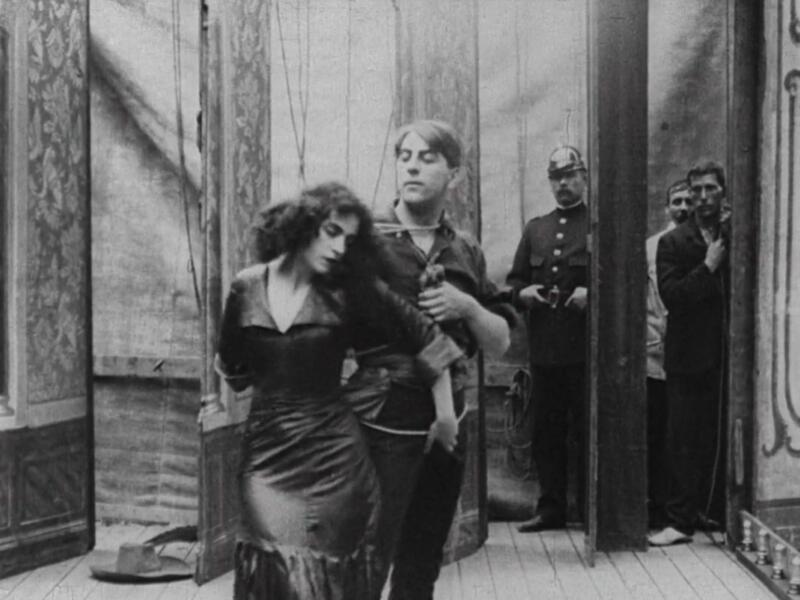
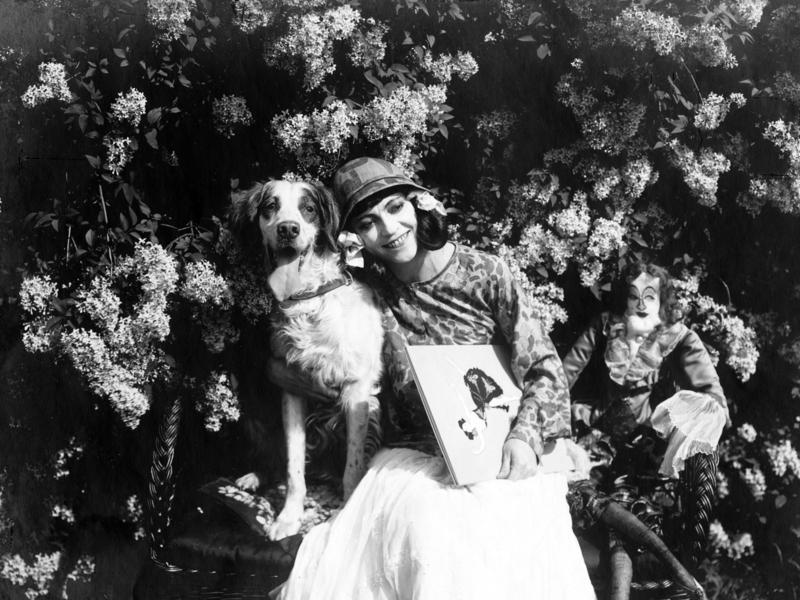
When Asta Nielsen was to give a pantomime performance in Vienna in 1913 (see Streit 2009; Grimm 2025, 335–339), she arrived a day early to avoid the fan crowds expected at the train station. Her anxiety was well-founded: a few weeks later, between 4,000 and 30,000 people are reported to have gathered at the train station in Budapest to greet her (Grimm 2023, 132). Even so, arriving the night before her expected arrival did not mean that she could escape her fans in Vienna, as a ”pyramid of letters” was already waiting for her in her hotel room. She recalls in her memoirs:
I knew all too well the flood of autograph demands that overwhelm every person working in film. Interchangeable and completely unmotivated as they were, the ones I received in Berlin always made their way to the desk of my secretary, whose task it was to sign my name and thus keep the peace.
Requests for assistance tended to be, if not exactly uplifting, at least more varied. Every famous artist is familiar with them, but outsiders have no idea what people ask celebrities for, ranging from land, business equipment, and pianos to the hats one has worn in a film or the luxury lingerie one is presumed to possess. The most bizarre reasons for these requests are laid out (...). (Nielsen 2022, 168–169)
Here, fan mail – as is quite typical of celebrity memoirs – is framed within a discourse of personal imposition and ridicule in equal measure. The use of the metaphor ”flood” and the characterization as ”interchangeable” rhetorically positions fan mail as akin to a mass-produced industrial product, and accordingly it is not Asta Nielsen herself, but her secretary who has to take care of the piles. The fans’ alleged desires, which focus on the most intimate details – such as luxury lingerie – and thus literally seek to undress Nielsen, appear pathological at the least when, in the context of fan mail just a few lines later in Nielsen’s memoirs, the film industry is accused of having an ”instinct for mass psychosis” (Nielsen 2022, 169). The letter-writing fans can thus easily be interpreted as embodiments of an mass audience that, if not directly sick, is at least psychologically deranged. In short, the fans appear in Nielsen’s memoirs as a painful reminder of the cultural-industrial, business side of film production, which stands in a permanent state of tension with film as a new art form – a form of which Asta Nielsen saw herself as the foremost representative.
Approaching Asta Nielsen through the lens of Celebrity Studies has long been an established feature of the vibrant field of research on her (cf. e.g. Schlüpmann et al. 2009; Loiperdinger and Jung 2013). However, a methodologically comparable approach, based on and inspired by Fandom Studies, has remained the exception, although reception studies have played a significant role in research over the past 15 years, not the least thanks to what one might call the ’Loiperdinger school’. True, the ’Astatics’, as Nielsen’s fans sometimes were derisively dubbed in the press at the time (Grimm 2023, 118; 2025, 379), were explicitly taken up as a topic by Andrea Haller (cf. 2009, 2010, 2016, 193–215) and Friederike Grimm (cf. 2023, 2025, 379–387). Both provide illuminating and often highly entertaining findings, including quotes from purported fan letters that were printed in the press (Grimm 2023, 120). While these explorations of the realm of Asta Nielsen fandom are commendable, one must not overlook the fact that ’fans’ here are ultimately a media construct. Haller and Grimm base their work on press reports, photographs, ads, and more or less staged films. These sources are undoubtedly evidential, attesting to Asta Nielsen’s immense popularity and the existence of a broad fan base, yet, as second-hand accounts, they are not enunciative since the fans themselves do not speak. They only become visible as the discursive or iconographic constructions of others, which, ultimately, can never entirely escape the suspicion of Barnumian exaggeration or interest-driven denigration. Surely, film magazines and women’s magazines had to base their descriptions of fandom and fandom practices on readers’ lived experiences due to their strong focus on readership (already for economic reasons). However, does this mean that a ”self-interpretation of the historical actors” – including the fans – can be found or ”surmised” in these magazines, as Haller assumes (2016, 194)? Such an argument does not pay enough attention to the difference between fans as media constructs and empirical fans, nor to the difference between fans and the general audience. Fans are not simply a pars pro toto of the audience but rather a specific group, especially when they are fans of a particular actor, that often stands in a relationship of mutual tension with the majority of the audience addressed in these magazines.
Asta Nielsen’s empirical fans remain an area of research yet to be explored, and this article intends to initiate this scholarly endeavour by looking at Nielsen’s fan mail.
Fans seen from the perspective of a sociology of laypeople
In order to counter the long-dominant pathologizing perspective on fans with a productive understanding of fandom, Fandom Studies has, since its actual beginnings in the 1990s, primarily approached fandom as a (media-)cultural and social phenomenon, strongly committed to the premises of Cultural Studies (Cavicchi and Schröder 2026, 10–15). However, sociological theories were not introduced to the extent that one might have expected. The most important exception is, of course, the work of the French sociologist Pierre Bourdieu, who was primarily drawn upon in the second wave of Fandom Studies to understand ”the replication of social and cultural hierarchies within fan cultures and subcultures” (cf. Sandvoss, Gray and Harrington 2017, 5), i.e. the social interaction among fans.
In Fran Osrečki’s recent sociological study on Laien: eine Soziologie des Nicht-Wissens (2025), the focus is programmatically on laypeople in their most common form, ”as audiences who are passive, uninformed, ignorant, or simply uninterested in the workings of functional systems” (173)1. Consequently, fans, as an active, well-informed, curious part of the audience, are largely ignored, although they are laypeople. However, Osrečki’s reasoning, inspired by systems theory, may still help us understand both fans as phenomena and why Asta Nielsen found her fan mail to be a nuisance – and sometimes a welcome appreciation of her work, as we will see.
In a way, the condemnation of her fan mail, quoted at the beginning, has a parallel in a Bourdieuian view of laypeople: For Bourdieu, the participation of laypeople is a ”gateway for field-foreign (e.g., economic) conditioning”, as Osrečki summarizes (2025, 53). The main narrative in Asta Nielsen’s memoirs, as well as the autobiographical texts she published in the German newspaper B.Z. am Mittag in 1928, was about her efforts to turn film into an art form and thus autonomize the field of film. This autonomization involved, for instance, the establishing and differentiating of social roles (like film actor or actress, script writer, director, film critic etc.) and values (like criteria specifically for judging film acting, film criticism etc.). In this way, the field of film was delineated as its own field, and a field-specific sort of ’capital’ emerged in the 1910s and 1920s.
According to Bourdieu, struggles within an artistic field are always struggles for ”le monopole du pouvoir de consécration” (Bourdieu 1992, 311), that is, the right to define who legitimately belongs to the field and who does not. In a Bourdieuian perspective, the exclusion, or at least marginalization of laypeople, is a logical step in this process of autonomization and must accordingly be considered an achievement (Osrečki 2025, 52). While fans (as laypeople) thus become bearers of heteronomic values that threaten the autonomizing field as an artistic one, Asta Nielsen proudly recites praise from other artists in her autobiographical texts (Seydel and Hagedorff 1984, 82; Nielsen 2022, 148). The reason for this is obvious, as this praise reinforces her conception of film as an autonomous field that is ideally concerned solely with art.
Osrečki, however, proposes a different, much more positive view, stating that laypeople are actually playing a positive role in establishing autonomizing systems. Drawing on Niklas Luhmann, he argues that ”the autonomy of a functional system and the inclusion of the audience are two sides of the same coin” (2025, 274). Systems become autonomous when they are not ‘columnized’, meaning that the decisions made within the system are not determined by the roles of the actors in other systems. Rather, these decisions actually happen inside the system, which can protect itself from direct external interference as an autonomous one (204–218). Laypeople ”draw upon a multitude of conflicting role orientations, options, and interests, none of which they are permanently committed to, and among which they cannot establish a permanent order of preference” (213), and it is precisely because of this ability – in short, because of the (potentially empowering) freedom of choice enjoyed by the layperson, his or her agency – that laypeople can make a constitutive contribution to the system’s autonomy, even if this means pestering a star for his autograph.
Osrečki’s sociological reevaluation of laypeople not only allows for an explanation why fans, as laypeople, cannot simply be reduced to embodiments of a threatening economic-industrial logic that is essentially foreign or heteronomic to the autonomizing field of film. If we consider that film fandom came to stay and that it became a constantly more institutionalized part of the film field, with its own magazines, communication channels, and organization forms, Osrečki provides a far better model for understanding the diversity of fan practices and fans’ (shifting) engagement with the stars. And it might explain why a star like Asta Nielsen on the one hand distanced herself publicly from her fan mail, and on the other hand, as we will see, held on to her fan mail.
”Owing your esteemed address to 'Pazzo’s letters'”
Returning to the fan mail awaiting Asta Nielsen in her hotel room, it is worth noting that this first mention of fan mail in her memoirs occurs during her stay at a hotel as a guest mime artist. This is no coincidence: an often-overlooked problem faced by early film fans in the 1910s was the difficulty of making contact at all with the star they admired. In the history of fandom, this was a new problem, brought about by the technically mediated nature of the star and the resulting disembodiment in the reception space. Fans of theater actresses, singers, or dancers shared a concrete space with the stars and could wait for them at the stage entrance or on the street. On the other hand, early movie stars – especially international ones – were, as shadows on the screen, atopic and unlocatable.
Therefore, pantomime or theater performances, as well as visits by the stars to local cinemas, were popular opportunities to ’locate’ them and perhaps even come into physical contact with them. For instance, Hermann Neimke, according to his own account an avid admirer of Asta Nielsen since his earliest youth, took advantage of one of her theater performances to give her a golden cigarette case as she left the theater (Neimke 1926). The star’s materialization at such performances was also a solution to the problem of ascertaining a postal address where letters could be sent. Neimke was certainly an exception, as the most common (and often only possible) way to get in touch with the star was by making use of media themselves, i.e., mailing, which highlights the centrality of fan mail in early film fandom. Sending one’s epistles to a hotel where a star was staying during a visit, as reported by the press, was a welcome solution to the address problem (and, as can be seen from fan mail, fans even tried phoning their beloved stars in their hotel rooms, cf. Tabib 1919).
However, such information about the star’s whereabouts was a stroke of luck. As Asta Nielsen’s fan mail shows, she also received letters addressed to the film company she worked for (and the Danish Nordisk Filmskompagniet, even after she was no longer employed by it), to the Deutscher Bühnen-Klub (Fuchs 1913), to women’s magazines like Elegante Welt, which announced in 1914 that letters to Asta Nielsen could be sent through the editors (Haller 2009, 332), to the French film magazine Ciné-Miroir, and probably even letters simply sent to ”Asta Nielsen, Copenhagen”. Admittedly, the last address is a guess, but a well-founded one: In the Austrian periodical Das Welttheater, the readers were told in 1912 that the address ”Asta Nielsen, Copenhagen”, is sufficient (O.T. 1912).2 And a Julia D. White thanked Asta Nielsen in 1913 for a photo, which ”was an unexpected pleasure as I thought the address would be too vague to find you” (White 1913). Unfortunately, her initial letter plus envelope seem not to exist anymore. However, other letter writers also commented on their surprise that they received a photograph despite the incompleteness of the address. A postcard sent by two German soldiers from Russia in 1916 may illustrate the vagueness of such addresses: ”Miss Asta Nielsen, film artist, Berlin” (Hano and August 1916).
Of course, when using such indirect or vague addresses, the letter writers could never be sure whether their letters would actually reach Asta Nielsen. A private address was to be preferred, but Nielsen kept hers secret for several years. At first glance, this seems surprising given that she was likely the film star – at least in the German-speaking world – who received the earliest press coverage. Significantly, she was the first film star to appear in women’s magazines (Haller 2009; 2016, 206), and the first issue of Illustrierte Kino-Woche – the first German periodical on cinema that was not a trade journal – featured her on the cover in 1913. Keeping her address a secret certainly also had to do with her aversion to certain consequences of her popularity: In her memoirs, she describes herself as a ”prisoner” (2022, 196) of her popularity, which she calls ”hell on earth” and which made it virtually impossible for her to have a private life outdoors outside the studio, except when she traveled to Denmark (2022, 148). When Asta Nielsen moved to Berlin in 1912 to the prestigious Kaiserallee 203, she seems to have made sure that neither her name nor her address was listed in the Berliner Adreßbuch in the following years.
However, the secrecy of her address was no exception during those early years of film stardom, when private information about the stars, such as their addresses, age or matrimonial status, was usually kept confidential. In his seminal study on the emergence of film stardom in the USA in the 1910s, DeCordova described a progression from ’picture personalities’ (”as a personality extrapolated from films”) to ’stars’ (”as someone with a private life distinct from screen image”) (2001, 147). The press coverage of the actors and actresses played a crucial role in this transition. The fan magazine Photoplay, for instance, told its readers in 1912: ”We prefer not to say anything as to the relationship of the various actors and actresses as such matters are purely personal.” (”Question Box” 1912, 94). It was not until the turn of the year 1913–14 that this editorial policy changed. Private addresses were also not published for a long time; as late as 1915, it was stated that: ”Yes, the players are usually glad to hear from their friends, but they must be addressed in care of their respective companies.” (”Questions and Answers” 1915, 158).
In German-speaking countries, the press exercised even greater restraint than in the United States when it came to publishing private information, despite the fans’ demands. Although the Spezial-Nummer of the Asta Nielsen-Zeitung – which served as a kind of marketing brochure for the new film star – had published the Copenhagen address of her husband Urban Gad as early as 1911 (Dr. M. 1911, 4; for more information on the newspaper see Grimm 2021), this remained an exception for quite a long time. In general, until the end of World War I, magazines had a policy of not providing any information about film actors’ private circumstances, including private addresses. This applied both to women’s magazines (for Elegante Welt, see Haller 2016, 219) and the fan press, which remained extremely sparse until 1919 anyway. In Illustrierte Film-Woche, for example, the editors refused in 1917 to publish the address of Asta Nielsen, among others, ”since we must assume that these busy movie stars would not be very grateful to us for disseminating their addresses” (”Sprechsaal” 1917). It was not until 1918 that this attitude changed. Egon Jacobsohn (also known as Egon Jameson after he was forced into British exile in 1934), a journalist who had specialized in film from an early stage, added an appendix to his 1918 book Flimmeritis. Was jeder vom Kino wissen muß containing the addresses of film actors (Jacobsohn 1918, 41–44).
The first – and, for a long time, the last – mention of an address of Asta Nielsen in the press in 1911. However, it is worth noting that the street name is misspelled (it should be written as “Dronningens Tværgade” or at least ’’Dronningens Tvärgade”) and the address is that of her husband, Urban Gad.
Although Asta Nielsen’s name is listed in Flimmeritis, the only information provided is: ”Copenhagen and traveling, her exact address is currently unknown” (Jacobsohn 1918, 41). Not only was sending fan mail to Asta Nielsen challenging because she was not interested (to put it mildly) in making her address public, but she was also living a rather nomadic life at that time after giving up her Berlin household during the war. On top of that, she worked for different film companies. Accordingly, a publication like Grosser’s Wege zum Film (1919) praised Asta Nielsen as an ”artist of global renown” (Grosser 1919, 26), yet failed to provide her address, despite listing over a hundred mailing addresses of other female stars, along with their marital statuses. In his 1919 edition of Flimmeritis, Jacobsohn was already better informed: Asta Nielsen’s mail could be sent to the Hotel Esplanade in Berlin (Jacobsohn 1919, 48), where she came to reside for two years from 1919 to 1921 (Beuys 2020, 191, 195). The address of the hotel was also listed in Olaf Skolnar’s Illustrierter Film-Almanach auf das Jahr 1921, although it is not disclosed that ”Bellevuestr. 16–18” (Skolnar 1920, 177) was not a household address. Asta Nielsen did not have her own household again until 1922, when she returned to Kaiserallee 203 (Beuys 2020, 214). In the Berliner Adreßbuch, however, she remained untraceable. At least a ”Czmara, G.” was mentioned for the first time in 1925 at Kaiserallee 203: this was a misspelling of Gregori Chmara, Asta Nielsen’s partner (and alleged husband) at the time, whom she lived with and who appears under his correct name in the personal section of the address book for the same year.
The most likely explanation for the fact that, starting in 1925, at least Chmara’s name appears in the address book is surely that the address Kaiserallee 203 had become public knowledge anyway. However, the turning point did not come until 1924: While the ’letters-to-the-editor’ columnist “Pazzo” in the Filmwoche as late as December 1923 gave out the address of Art-Film in Berlin as Asta Nielsen’s mailing address (Christmas issue, 10), he provided his readers with Asta Nielsen’s private address in 1924 (”Pazzo’s Briefe”, 1924, issue 23, 480; issue 24, 508, issue 25, 537; issue 32, 727; issue 50, 1170). The fact that he gave out her address no less than five times – and three times in a row in consecutive issues – surely indicates how many requests he must have received from fans who wanted to write to Asta Nielsen and had inquired about her address. At the time, the Filmwoche was the most widely read fan magazine in the German language area, and a fan letter to Asta Nielsen notably refers to ‘Pazzo” as a source of her address (quoted in the subheading; Heine 1925).
Locating Asta Nielsen’s fan mail
Starting in 1912, the press often mentioned Asta Nielsen’s fan mail in their coverage of her. Two examples from the highly meritorious Importing Asta Nielsen Database (IANDb) and one from the first biography of Asta Nielsen, written by the journalist Pablo Diaz:
Every time she returns to Copenhagen, her home is piled high with letters from strangers who simply adore her, pour out their hearts to her, and reveal all their desires and passions (Peters 1912).
Countless letters pour in to the artist, from actors and artists, as well as from lords and officers, and from strangers all over the world who have no claim to writing to her other than their desire to express their love and admiration for her art (”Asta Nielsens Lebenslauf” 1913, 10).
I think Asta Nielsen holds the record for the number of letters received by anyone in the world. (...) Anyone who has ever visited her address in Westergade knows that every mail delivery is guaranteed to bring letters: red and yellow, long and wide, thick and thin (Diaz 1920, 64).
Even a parody of a fan letter to Asta Nielsen was published in 1919 in Bunte Film-Blätter. The fictional letter-writer is called Eduard Milchbrei (literally: “milk porridge”), an apprentice at the clothing store Morgenstern, Sonnenblum & Co. (which is perhaps intended to invoke a stereotype about Jews and connotate fandom negatively as a typical Jewish practice). Milchbrei is described as a hardcore fan of Asta Nielsen: He has seen every one of her films six times, has 34 postcards of her hanging above his bed, and named his dachshund ’’Knasta” (perhaps a play on the Yiddish word ’’knepel”= ’’friend”, ’’buddy”?). The cited letter excerpt (with questionable grammar in the original German) is a prime example of the mocking and condescending way in which the press used to portray the fan letter genre and its writers as wacky and over the top:
For several months now, you [Asta Nielsen] have crept into my heart and taken a firm hold of it. My soul is intoxicated with passion and is completely at the mercy of my heart’s elemental force, in which you have, as I have already said, taken root. (...) It is my sincere, utterly honest love, my deep, genuine love for you, my lady, purely fanatical, and I am even more infatuated with you. Can’t you love me too? I just want to be near you for an hour and cover your face with kisses. I want to love only you. I’ve written farewell letters to Schmidt’s Emma and Braids-Lotte, who’ve been chasing after me for a long time. I don’t want anyone else but you – if only you knew how my heart beats for you. (...) Please write to me, so that I won’t be unhappy, so that I can pull your head to my chest and stroke your beautiful hair so softly. I must see you, otherwise I will die, (...) so be sure to write to me, otherwise I must take the path that leads past the houses behind the high walls, where all the people lie who are dead and can no longer live or love (”Eduard Milchbrei’s Geständnis” 1919).
In the passage from her memoirs quoted at the beginning, Asta Nielsen gives the impression that her fan mail was nothing but a nuisance. Yet if we are to believe Diaz 26 years earlier, then Asta Nielsen actually enjoyed receiving and reading her daily batch of fan mail: ”She reads them all. They are carefully opened and stacked, and then the actress reads them one by one over her morning coffee.” (Diaz 1920, 64). In her memoirs there are also indications that she actually cared more about her fan mail than the quoted excerpt suggests and that she considered at least some of it valuable enough to preserve. The attentive reader of her memoirs learns in passing that, upon her departure for Denmark in 1916, she was traveling with a suitcase full of letters, which was confiscated by the police as suspicious and which she left behind in Berlin (Nielsen 2022, 234). The letter writers are characterized in the Danish original as ”Publikum”, which the translator Julie K. Allen has rendered somewhat modernized but accurately as ”fans”. In Asta Nielsen’s autobiographical texts, which appeared in 1928 under the heading ”Mein Weg im Film”, we even learn who these fans supposedly were, whose letters were so important to her: ”Letters from German soldiers in the trenches (...) who had asked me for photographs and autographs to use as amulets” (Nielsen 1928) – a detail that would most likely have caused consternation among Danish readers in 1946 and was probably omitted for that reason.
In fact, about 170 fan letters and postcards addressed to Asta Nielsen have survived to this day: approximately 130 in Asta Nielsen’s archive at University Library Lund (which I have already quoted from), one postcard at the Deutsche Kinemathek in Berlin, and approximately 40 letters and postcards in a private Danish collection, which will hopefully be published soon. (The use of the word ’’approximately” is due to the fact that, in some cases, it is open to debate whether the items in question constitute fan mail: My arguably fuzzy and porous definition is that fan mail is defined heuristically as letters or postcards expressing a strong, often passionate interest in the celebrity, mostly admiration or veneration, sent by people whom the celebrity does not know personally, thereby creating what Horton and Wohl termed a ”parasocial relationship” (Horton and Wohl 1956; see even Cavicchi and Schröder 2026, 23–28, for an extensive discussion of ‘fandom’).
The majority of the mail can be traced directly back to Asta Nielsen, i.e., it was kept by her personally. As a ”statement” in the Deutsche Kinemathek in Berlin attests, Asta Nielsen’s last husband, Christian Theede, handed over a ”nearly complete (numbering well over 10,000 items) film archive on ‘Die Asta’" to the Swedish film historian Gustav D. Postén shortly before Asta Nielsen’s death as source material for the biography Postén intended to write about Nielsen (Theede 1972). Asta Nielsen had known Postén since 1965, and over the years, they had become friends; in fact, she had already entrusted Postén with documents earlier to ensure her posthumous afterlife in research (cf. Beuys 2020, 394, 411, 418–419, 426–427, 431). This Asta Nielsen archive, possibly expanded to include additional acquisitions, was then acquired by the Lund University Library in 2012. The fan letters were first used as a source in Barbara Beuy’s biography of Asta Nielsen (Beuys 2020, 167–169, 189, 247, and passim).
The fact that at least some of the letters now archived in Lund were originally kept by Asta Nielsen herself is evident not only from the archive’s provenance, but also from the comments she left on some of the letters in ballpoint pen (which was not in common use in Denmark before the 1950s) and in scrawled old-lady handwriting. Perhaps these comments were meant to be a memory aid, but more likely to help with Postén’s unpublished biography. For example, Nielsen wrote on a letter from an admirer: ”It was he who, without asking me, now only needed his father’s consent to our marriage. I was married to Peter Urban” (Semper 1913). The letter from another admirer was commented with ”sent me boxes of tropical fruit several times” (Vidal 1912)

Asta Nielsen’s later comment on letter from Semper (above), dated 3 February 1913, and on letter from Georges Vidal (below), dated 18 December 1912, University Library Lund, Asta Nielsen’s archive.
The preserved fan mail to Asta Nielsen: a legacy fraught with problems
How many fan letters might Asta Nielsen have received during the silent era? As a rule, no figures are mentioned, as seen above, just ”piles” or ”pyramids” of letters. The only number ever given is when the journalist Diaz quotes her as saying the following about her fan mail: ”It’s a great psychological thrill to hear from a hundred thousand different people like that” (Diaz 1920, 64). However, since fan mail served as a barometer of a star’s popularity, astronomical figures like this, as well as others reported in the press regarding other stars (for example, Clara Bow should have received nearly 34,000 letters in April 1928 alone (Larkin 1928, 39)) should be viewed primarily through the lens of publicity as an advertising ploy.
The only realistic reference point we have to calculate the amount of Asta Nielsen’s fan mail is by comparing it to the fan mail collection of her actor colleague (and close friend), Olaf Fønss, who actually saved all his fan mail. In his most popular year, 1917, when Fønss caused quite a craze as Homunculus in the German series of the same name, he received 377 letters and postcards (status as of July 2026), as well as presumably a share of the undated fan mail in his collection. There is no doubt that Asta Nielsen was a bigger star than Fønss, but she was not exactly the kind of star you could ”get up close and personal with”, as Haller convincingly stated (2009, 335). Therefore, an estimate of the amount of fan mail Asta Nielsen received annually might be in the neighborhood of 1,000 letters and postcards. If you extrapolate that over her 21-year film career, it amounts to a five-figure number.
When we compare this number with the approximately 170 fan letters from the silent era that have survived to this day, the question immediately arises as to the representativeness of the surviving letters and their writers, both in terms of the fan letters addressed to Asta Nielsen and in terms of Asta Nielsen’s fans in general. In both cases, statistical representativeness must be dismissed. This is because the fan letters still preserved today are the product of selection criteria on both the sender’s and the recipient’s sides: On the sender’s side, they were sent by an elite audience who could utilize resources such as time, money for stationery and postage, writing skills, and so on, in its attempt to make contact with the admired star. On the recipient’s side, Asta Nielsen kept only a fraction of the letters she received (not to mention contingencies such as the aforementioned loss of letters during wartime).

Dated fan mail to Asta Nielsen in the silent era by year.
The approximately 130 mail items from the silent film era, archived in Lund and Berlin, that have been analyzed for our project ’’Fan mail to Danish Film Stars in the 1910s” spans the years 1911 to 1930, with 1913 marking the absolute peak – which coincides with Asta Nielsen’s likely most successful year as a silent film star. The letters and postcards are written in 12 languages (in order of frequency: German, French, English, Spanish, Portuguese, Swedish, Danish, Dutch, Hungarian, Italian, Russian, Estonian). Asta Nielsen received fan mail from all over the world, from South America to Australia. Due to territorial changes in Europe during the silent film era, the attribution to specific countries before and after 1918 is not always comparable, but by far the most letters came from the German Empire or the Weimar Republic (29 letters), followed by Brazil3 and Belgium (9 each), England (8), Italy (7), and Spain (6).

The worldwide source locations of fan letters to Asta Nielsen as of July 2026 (green markers: street and house number is known; red marker: district is known or identifiable, but not street and house number; purple marker: only city is known; blue marker: only country is known).
For an updated and scalable version please visit https://databasefanmail.uni-koeln.de/search/public/map.php?vis=1 and use "Asta Nielsen" on the right to filter the results)
The letters and postcards were sent by over 100 different senders. A notable difference, when compared to Fønss’ fan mail, is that 64% were written by men, which is the highest proportion of men in all of our fan mail collections examined so far. This high proportion of men resonates with Grimm’s observation that male fans were surprisingly prominent in the media’s portrayal, both visual and logographic, of Asta Nielsen’s fans (2023, 119–125; 2025, 382–385). But does this high percentage of men actually reflect the composition of the (letter-writing) fan base? Or is this an expression of Nielsen’s own selection criteria? For her project to elevate silent film to a new art form, she was most likely primarily interested in recognition by men as the guardians of hegemonic culture.

Only photographs of male fans are to be found in Asta Nielsen’s fan mail – which might be due to her wish for male recognition (all pictures shown with kind permission from the University Library Lund, Asta Nielsen’s archive)
In general, the letters should be understood as a space of overlap between the fans’ total (written) discourse and Asta Nielsen’s gatekeeping motivation for preserving specific letters and postcards. While the fan’s discourse can be reconstructed to a certain extent, albeit the collection is highly selective, Asta Nielsen’s motivation can only be inferred indirectly, though with a certain degree of reliability.
Worldwide fame and exemplarity as selection criteria
Another notable difference compared to Fønss’ mail is that the maximum number of letters from a single fan to Asta Nielsen is four, with an average of only 1.3. In contrast, the Fønss collection contains up to several dozen letters written by the same fan. There is no reason to assume that Asta Nielsen’s fans behaved any differently, and several letters sent to her actually reference previously sent letters that are not preserved. Of course, one reason could be that they were simply lost when Asta Nielsen moved around. Overall, however, one gets the impression that she primarily kept mail for two reasons: First, mail bearing witness to her global fame in countries like Australia, Bulgaria, Egypt, Greece, Italy, Mexico, Poland, Russia, Spain, Uruguay, and the U.S. This might explain why there are many rather standardized requests for autographs to be found in the collection, whose sole significance seems to lie in their place of origin. Second, she kept mail she considered to be exemplary, as is obvious in many of the more substantive letters. Here we encounter predictable inquiries about whether the letter writer might be suited to be an actor or actress, as well as suggestions for roles and offers of screenplays, but also the typical begging letter or cover letters accompanying ads and film programs for her films or fan-made gifts such as poems, songs, compositions, drawings, or oil paintings. Somewhat more unusual requests focus on stage costumes she had worn, a handkerchief, or a tuft of her black hair. Fans even ask for photographs taken according to very specific instructions (sitting on the sofa, in full-body view, with a small dog). The latter requests could be read as fans trying to take on the role of the director, reversing the power imbalance between fan and star. Compared to the bizarre proposals and whimsical requests mentioned by Asta Nielsen in her memoirs or in the allegedly authentic letters reported in the press (cf. Grimm 2025, 381), it is striking that the surviving letters are far less bizarre, although Asta Nielsen would certainly have kept the more bizarre examples. As a rule, fan letters reported in the press and the stars’ discourse about their letters should be viewed more from the perspective of sensationalist news value rather than from that of authenticity.

The gifts mentioned in the letters are normally lost. A rare exception is this drawing by Otto Schleier, sent to his ”ideal artist” and showing Asta Nielsen in 'Jugend und Tollheit', according to Schleier (Schleier 1913). However, this demure, docile girl is hard to reconcile with Jesta in the movie, who takes matters into her own hands and takes on a male role. Is the drawing, sent by a man, a critical commentary on Asta Nielsen’s debut in a trouser role?
Asta Nielsen also kept particularly elaborate tributes to herself as ”queen of the movies” and touching letters full of declarations of euphoric love. For example, a 17-year-old student from Naples named Desiderio Raffaele asks her to kindly consider his words of admiration, ”and your name will live on within me only as long as I live, as long as life remains sweet to me” (Raffaele 1912a). Nine years later, a Hans Fischer from Hamburg praises Asta Nielsen’s perfection and declares, ”For this, I love you so infinitely, so deeply, so passionately, so childishly, and so purely, as no other person can” (Fischer 1921). Asta Nielsen was certainly also delighted by Marianne Jahn’s letter from Liegnitz (today Legnica): ”When you come, everything fades away to make way for your beauty. Your wondrous eyes shine with the redemption of despair. Asta Nielsen, you are not an artist. You are art incarnate. You are like a violin with fifty strings.” (Jahn 1924) Such panegyrics on Asta Nielsen were surely often an outpouring of genuine feelings. However, one of the most florid letters in the collection cautions against underestimating the rhetorical dimension of fan letters:
Divinely gifted artist!
The everlasting light of your exquisite art – which aims to finally help humanity’s quest for nobility on earth achieve complete victory over the evil that has taken root – worked wonders here as well.
I know that in appreciating such values, I must not stray from the realm of the ideal; for I would then have to come to terms with the human aspect.
I have done so nonetheless, and in doing so, my feelings have soared to immeasurable heights, which convinces me that in my heart, as far as your divinely gifted person is concerned, the ideal and the real can be perfectly united.
I have imprinted your ideal image upon my soul (...) (Kecerin n.d.).
She continues in the same vein. What Asta Nielsen certainly did not know: Josefine Kecerin from Zagreb sent the same text verbatim to Olaf Fønss, when asking him for a picture (Kecerin 1914).
Another reason for keeping letters was obviously when fans expressed their sadness about the lack of her presence, both in real life and in local cinemas. For example, Hanne Kuyt from Berlin wrote to assure Asta Nielsen how much she was missed in Berlin, claiming that ”thousands are waiting for the moment that will bring you back to Berlin”, that no one ”can worship and admire you more than I do” and that Berlin will be charming again only when Asta Nielsen returns (Kuyt n.d.).4 And L. Boyce from London was devastated when England prohibited German films during World War I:
You have come as an angel into my life, and I could not possibly live without you now. Your life is my life. I love you more than my life, yes, a thousand times more. (...) I should have been quite contented for the rest of my days, if only I could have seen your films, but now they are going to take them from me, to ruin my happiness, interest in work, and everything (Boyce 1916).
Consecrating mail
Two groups of senders stand out in particular in Asta Nielsen’s fan mail: on the one hand companions in art like other actors, as well as singers, painters, composers, musicians, and conductors; on the other hand soldiers. Presumably, the letters from the commilitones artes were considered to be worth preserving, because their senders from the more traditional, undisputed arts affirmed Asta Nielsen’s status as a true artist, at a time when no other consecration procedures (see above) in the field of film had been established, such as the bestowal of awards, inclusion in a film canon, or interest by film museums. But what about the letters sent from the trenches during World War I?
As the excerpt from her reminiscences in B.Z. am Mittag quoted above demonstrated, Asta Nielsen cared enough about this kind of fan mail that she wanted to take it with her to Denmark. To my knowledge, no study has been conducted on Asta Nielsen’s prominence in makeshift military cinemas during the war. However, her fan mail convincingly attests to it (see even Beuys 2020, 167–169), as well as the author Ernst Mungenast, who began his book on Asta Nielsen with this personal memory:
Once I found a picture of Asta Nielsen. In the middle of the war [Mungenast was 18 at that time]. In Champagne. In a shelter that was full of the wounded, the dying, and the dead. The picture was wedged into the golden frame of a mirror hanging on the rough planks above a smoldering tallow candle. I had reached for the picture with my dirty fingers and, when I recognized it, exclaimed: Asta Nielsen! For half a second, the whimpering and gasping of my comrades fell silent; they lay scattered about like animals in a dull fever, wrapped in rags and tatters. (…) Some comrades wanted to see the picture, and so it was passed around, and everyone became quite different, strangely serious and sad, stopped cursing, and said in altered voices: ”Yes, that’s her.” (Mungenast 1928, 11).
Contemporary monographs on Asta Nielsen like Diaz’ or Mungenast’s often blurred the line between factual writing and unreliable hagiography because their intended readership was not the least fans. But the cohesive power of the soldiers’ admiration for Asta Nielsen is also evident in the fan mail they sent from the front, when soldiers mentioned screenings of Asta Nielsen films or reportedly wrote on behalf of as many as thirty comrades or an unspecified number of ”warriors grayed by the smoke of battle” (Korte 1918), or where postcards contained only a greeting followed by a multitude of largely illegible signatures.

Fr. Hollmann sent his greeting allegedly ”on behalf of 30 comrades from all ranks, up to the captain” (Hollmann 1916). The comment on the letter (”from World War I”) was added by Asta Nielsen in later years (University Library Lund, Asta Nielsen’s archive, box 49).
The importance of such letters and postcards to Asta Nielsen derives probably from the life-threatening situation these senders were in. The fact that she was adored as an ideal in the trenches was the ultimate confirmation of the profound impact of her work (and her person).
The fans, their agenda, their practices
Shifting the perspective towards the fans: How did they see their own role? What was important to them? What kind of practices were part of their fandom? To begin with, the term ‘fan’ – which came into common use in the United States starting in 1910 to describe emotionally involved, enthusiastic moviegoers – was not in use in non-anglophone Europe during the silent era. In general, the term ’fan’ or ’film fan’ did not become established in non-anglophone Europe until after World War II, under the influence of the United States, even though it had been used sporadically before 1945. However, it would be tantamount to indulging in linguistic essentialism to hastily conclude from this that there were no film fans during the silent film era (or, more generally, other types of fans before the term emerged in the 1880s) (Cavicchi and Schröder 2026, 24–25; Cavicchi 2026). The fans, at least, knew about themselves as a group phenomenon, which is sometimes self-ironically commented upon, when fans hope that ”maybe you’ll even spare me the exclamation: ’’Another idiot!’” (Weyssenhoff 1912).
The variety of terms still in common use outside the U.S. during the silent film era can actually be seen as an advantage, as it allows us to distinguish nuances that are lost in the later umbrella term ‘fan’. Not every letter writer attributes to himself a fan identity defined by a single term, but when they do, “admirer” or an equivalent term (’’Bewunderer”/’’Bewunderin”, ’’admirateur”/’’admiratrice”, ’’admirador”, ’’bewonderaar”/’’bewonderaarster”) is most commonly used (76%; status as of July 2026). In some cases, the admiration is cautiously depersonalized when it is added that one is an admirer of her unparalleled artistry, her acting, or cinema in general. ’’Worshiper” and broadly equivalent terms such as ’’devotee” or ’’Verehrer”/’’Verehrerin” are the second most employed terms (18%).
Although both terms are similar in that they express an emphatic affirmation of the cultural superiority of the person being addressed (Zink 2019, 210), the relationship between the fan and the star is nevertheless semanticized differently: Admiration defines the star ”as a role model to emulate, one who sets the standard for what is worth striving for” (Zink 2019, 213). Although the star serves as an ideal due to his or her extraordinary achievements, his or her ”achievement or virtue still falls within the realm of the explainable and possibly attainable” (Schindler 2019, 216). Adoration or worship, on the other hand, move the star toward transcendence, marking an insurmountable distance between the fan and the star: ”In contrast to admiration, adoration is directed not at role models, but at those who provide meaningful guidance and benefactors, who are perceived as superhuman or holy and thus beyond what can be understood or explained.”(Schindler 2019, 216) This ”insurmountable distance between the common worshipper and the famous object of worship” goes hand in hand with a ”subordinative tendency of worship” (Zink 2019, 213).
Two other terms used in the letters appeared only once each: “follower” (’’Anhängerin”), which conveys the idea of competition between stars and the clustering of fans into teams, thus putting Asta Nielsen on the same level as other stars with a fan following and at the same time drawing a parallel to the world of sports – undoubtedly unappreciated by Asta Nielsen. And in a late letter from 1929, sent from Porto in Portugal, we even encounter the term ’’le fanatique”, which may be an early loan from English: ”I am no longer the movie lover [in French: ’’cinéphile”] who comes to applaud you; I am the fanatic [in French: ’’le fanatique”] who comes to fall to my knees before your art, your beauty, and your unparalleled talent” (Cab 1929).
In a way, the quantitative prevalence of the comparatively understated self-description as an "admirer" clashes with the epiphanic moments that quite a few fans describe in their letters when they first saw Asta Nielsen on the screen (significantly, The Abyss is by far the most frequently mentioned movie in the fan letters).5 A few examples:
One day, as I was walking through the heart of Marseille, I saw you. Yes, I saw you, and certainly (...) that day I suffered, and I realize that my suffering is pent up and that, despite myself, I love you to death, for I can no longer live without you (Conte de Fiers 1912).
It was the first time I had ever seen the motion pictures – and you. And it was one of the most overwhelming experiences of my life (Epstein n.d.).
Dear Madam, without meaning to flatter you, you must possess something supernatural to be able to turn a young man’s head from such a great distance!/ Just imagine, dear Lady, that the first time I saw you on the big screen in the thrilling film "The Abyss", I immediately felt something mysterious take hold of my very being... and now, just for the pleasure of watching you, I go back to the movie theater twenty times in a row to see just one of your films (Vidal 1912).
Not long ago, I had the pleasure – combined with great emotion – of seeing you in a film produced by ”Nordisk,” shown here under the title ”The Abyss,” and, due to a psychological phenomenon that has persisted since that day, I have become captivated by you, making me one of your most sincere admirers (...) (Silvéna 1911).
Given that even professional film criticism only gradually developed a differentiated vocabulary in the 1910s and 1920s, it’s not surprising that fan letters are normally rather conceptually vague about the fascination sparked by Asta Nielsen and her films (the exception being a professor of an art academy who offered a nuanced critique of I.N.R.I.). As the last two text examples illustrate, fans sometimes refer to magical or psychic powers, or a metaphorical magnetism, ”the sublime and magical power of enthralling me” (Freire 1913), which invades one and renders one powerless. Such a construction could serve, not least, as an apology for flouting the rules of propriety and writing to a woman as a stranger.
Overall, the letters provide an illuminating insight into fan culture and fan practices. Although the fans drew, to quote Osrečki again, ”upon a multitude of conflicting role orientations, options, and interests” (2025, 213), what unites them is the intention to get in touch with the admired and/or adored star. However, this was usually limited to receiving a portrait postcard with an autograph. Diaz quotes Asta Nielsen as admitting outright that she just once wrote a response to a fan letter (1920, 64). Throughout her film career, she never publicly admitted that the sent postcards were, in fact, signed by her secretary, as she finally did in her memoirs in 1946. However, by the second half of the 1910s, it had become common knowledge that film stars, as a rule, did not usually answer their fan mail themselves. That fans had had their doubts since the very beginning, is articulated by Desiderio Raffele already in 1912: ”I’m afraid it wasn’t you who wrote to me.” (Raffaele 1912b) Still, the fans had to make do with that, although quite a few complained about it.
Predictably, the fan practice most often mentioned are repeated viewings of films: ”My sister and I make a point of seeing all your films several times” (White 1914), writes Julia D. White from London in 1914, and Helene Kluhn from Berlin proudly claimed as late as 1932 that she had seen Hamlet (which was released in Germany eleven years earlier) ten times (Kluhn 1932). The community-building character of fandom, often explored in Fandom Studies (Cavicchi and Schröder 2026, 27–28), becomes apparent when eight admirers wrote to Asta Nielsen in 1920 to announce the founding of the ”Club of friends of Asta Nielsen” in Recklinghausen, Germany (Jungmann 1920).
Other fan practices mainly focus on photographs. The long history of star photography in fandom, which dates back to the 1860s (Schröder 2026, 147–149), can make it easy to overlook the significance of film fandom being the first fandom where the object of fandom was entirely mediated by technology. At least during the time of ’picture celebrities’ (see above), the star on the screen was attested to have a questionable ontological existence, as a fan from Łódź elaborated on (the letter is undated, but was written before 1919):
Is there really an Asta Nielsen?
For those of us who are used to seeing you only in movies, used to seeing your name on posters in big letters, it seems to us that you are a fictional character: someone who doesn’t exist like the rest of us ordinary mortals. (Lausmer n.d.).
In his famous article ”The Work of Art in the Age of Mechanical Reproduction” (1935/36), Walter Benjamin argued, as is well known, that photography and film as products of mechanical reproduction lack the spatio-temporal uniqueness, the ‘aura’ that has traditionally distinguished works of art (Benjamin 1969). In an act of deceitful compensation, the film industry seeks to imitate the liquidated cult status that was the origin of art, by creating star cults as mimicry. However, when the film fan practices concerning star portraits were established in the first half of the 1910s, information about the stars on the screen was still sparse in Europe, as Lausmer’s letter illustrates. In this situation, fans did not necessarily have to see Asta Nielsen’s pictures as a re-presentation of the ‘real Asta Nielsen’, as would have been the case with photographs of known theater actors or opera singers: Asta Nielsen’s portrait was not an Abbild, i.e. an image derived from the original and because of its mechanically-produced nature devoid of any aura, but rather, because of its iconomorphic nature, a media equivalent of the likewise iconomorphic film and thus as much an underived, authentic original as the movie image itself.
The absence of an ontological gap, an image/reflection relationship between the two media images, one moving and one static, paved the way for potentially restoring the cult value of the portrait by practices ranging from iconolatry and iconophilia to simply staging Asta Nielsen’s (medial) presence in one’s daily life. On one end of the spectrum are fans who describe Asta Nielsen’s portrait coming to life at night (Renvall 1912); who wear her portrait as an amulet in war times or a ”relic” (da Silva 1912), who adorn her picture with flowers ”like an altarpiece on Corpus Christi” (Steppan 1916), who kiss it and sing love songs to it every evening. Toward the other end of the spectrum are fans who write in their letters that they have Asta Nielsen’s photograph displayed in their apartment: often framed under glass, the photograph is usually placed at the head of the bed or on the writing desk, sometimes decorated with fresh flowers. Fans ask local photographers to reproduce the picture so they can share it with friends. Even if they already have a copy at home, some still want a smaller, second one to carry around, probably in a locket, so Asta is never far away. In any case, the numerous practices related to photographs referred to in the letters attest to the central role of photographs among Asta Nielsen’s fans (and early film fandom in general) (Schröder 2026), sometimes reestablishing the traditional ritualistic basis of images in what one might call an anti-Benjaminian turn.
Modernity and trouser roles
In closing, let us take a look at how the discourse in the fan letters relates to two central truisms in research on Asta Nielsen. The interest in Asta Nielsen, which has existed since the 1980s, has been fueled in no small part by the conviction that she exerted a decisive influence on her films and that she embodied a new, empowering female role model, thus making her a prime example of the ‘New Woman’ in the early 20th century. This was linked by Allen not only to her films, but also to her cultural origins: ”Her star persona was identified with Scandinavia, in particular the image of a progressive, often transgressive, modern Scandinavian culture” (Allen 2012, 169).
However, while this is undoubtedly true when analyzing the films and the press discourse, the Scandinavian connection does not seem to have played a role in the fan letters, at least not in the ones that Asta Nielsen chose to preserve. Her Danish origin is often referenced, either directly or indirectly, e.g. by sending the letter to Copenhagen, by specifying Copenhagen as her place of residence, by metaphorizing her as the North Star, or by weaving a Danish greeting or idioms into the text. However, this origin is not explicitly semanticized, although, of course, contemporary connotations may resonate here. The only exception is a letter from a Bulgarian actor, who fought in the First Balkan War against the Ottomans. In the letter, he praises Asta Nielsen as ”a person of high cultural standing, in a country where freedom is protected and valued and tyranny is abhorred” (Mamartscheff 1912). However, in the two letters and the postcard Mamartscheff sent to Asta Nielsen, there is no hint at all that he knew that she was Danish, so this remark might as well have been a reference to Wilhelminian Germany, which certainly could look like a haven of freedom compared to the Ottoman Empire.
Another tenet of research on Asta Nielsen has been the emphasis put on her constant identity shifting, thus showing identity constructs, particularly of gender, to be ultimately arbitrary and fluid. Especially her cross-dressing trouser roles in the three films Jugend und Tollheit (1913, In a Fix), Das Liebes-ABC (1916, The Love Alphabet), and Hamlet (1921), as well as the mutability of her roles in general, attracted feminist attention early on. In recent decades, these roles helped ensure that Asta Nielsen has firmly secured a place as a ”pioneering figure” (Allen 2012, 194) even in the history of queer cinema. In the fan letters sent to Olaf Fønss, Betty Nansen and Clara Wieth, which we analyze in our research project, letters sometimes express queer desire, demonstrating that writing fan letters to distanced stars could provide a safe space for expressing such longings. In Asta Nielsen’s fan mail, however, there exists just a single letter that could be read as queer. Marianne Jahn, already mentioned above, first enthused about Asta Nielsen and then continued: ”If I were rich, I would send you roses. Dark, red roses. Fragrant as the night. Your eyes would caress my roses, and my heart would rejoice.” (Jahn 1924)
Of course, the absence of explicitly queer letters could easily be due to the selection made by the aging Asta Nielsen – or, for that matter, even the younger one, considering the surprising gender distribution in the collection. It is also worth remembering that Asta Nielsen deemed Hamlet, this milestone in queer cinema historiography, in retrospect ”as failed as it could possibly be” (letter, dated 29 April 1969, in Monty 1999, 178). In another letter from the same year, she approvingly quotes, ”when women start wearing trousers, Ragnarok is near” (letter, dated 22 April 1969, in Monty 1969, 176).

Asta Nielsen in trouser roles in 'In a Fix' ('Jugend und Tollheit') and in 'The ABC of Love' ('Das Liebes-ABC').
While explicit queer letters are not extant in the collection, there is still evidence that Asta Nielsen’s trouser roles were greatly appreciated by her female fans (for a (typical?) male perspective, see the drawing shown above). Three girls, two of them probably sisters, wrote in 1913 from Bristol to tell Asta Nielsen how much they enjoyed her acting. After providing Asta Nielsen with a list of all the films they have seen with her, thus underlining their fan competence, they particularly focus on Asta Nielsen in a Fix (Jugend und Tollheit, 1913). Unfortunately, the film featuring Asta Nielsen as a woman disguising herself as a man to fight for her love no longer exists, but the letter states precisely what the three girls loved about the movie: ”The last mentioned is our favourite, and we are longing to see it again. We absolutely fell in love with you taking the part of the opposite sex.” (Chanter, Chanter and White 1913). From the female fans’ perspective, Asta Nielsen provided them with empowering role models and envisioned new spaces of agency for them.
This article was written in the context of the research project ”Fan mail to Danish film stars in the 1910: Exploring the agency and practices of early film fans” (https://www.fanmail1910s.de/). I would like to thank the German Research Foundation DFG for funding the project 2024–2027 and the University Library Lund for permission to use and reproduce the fan mail to Asta Nielsen from its Asta Nielsen’s archive. Thanks also to Carina Eltrich as well as Jans Magnus Nikolaus and Diana W. Anselmo for their valuable contributions in transcribing and translating Asta Nielsen’s letters and for their support in general.
Notes
1. Unless otherwise noted, all translations in this article are my own.
2. I am indebted to Friederike Grimm for this information and for other references in the following text that she called my attention to and provided me with.
3. About Asta Nielsen’s reception in Brazil see Navistski (2013) and Freire (2022).
4. The letter is not dated with a year, but the Berliner Adreßbuch lists at the given address (Johannisstr. 3 in Berlin) an "E. Kuyt, housekeeper" from 1919 to 1923, a "H. Kuyt, secretary" (the daughter?) in 1925, then once again an "E. Kuyt" from 1925 onwards, first listed as "Mrs." (1926–1927) and then as "privatiere". Therefore, the letter could not have been sent before 1919.
5. Afgrunden (The Abyss) is mentioned six times, whereas all other films are just mentioned four times or less (status as of July 2026).
References
Allen, Julie K. (2012). Icons of Danish Modernity: Georg Brandes and Asta Nielsen. New Directions in Scandinavian Studies. Seattle and Copenhagen, University of Washington Press and Museum Tusculanum Press.
”Asta Nielsens Lebenslauf. Von besonderer Seite” (1913). In: Kinematographische Rundschau, 2 March 1913, no. 260, 7–10.
Benjamin, Walter (1969). ”The Work of Art in the Age of Mechanical Reproduction”. Translated by Harry Zohn. In: Walter Benjamin: Illuminations, ed. by Hannah Arendt. New York, Schocken.
Beuys, Barbara (2020). Asta Nielsen. Filmgenie und Neue Frau. Berlin, Insel.
Bourdieu, Pierre (1992). Les règles de l’art. Genèse et structure du champ littéraire. Paris, Éditions du Seuil.
Boyce, L. (1916). Letter to Asta Nielsen, 20 February 1916. University Library Lund, Asta Nielsen’s archive, box 2.
Cab, A. (1929). Letter to Asta Nielsen, 24 May 1929. University Library Lund, Asta Nielsen’s archive, box 3. [Unfortunately, the signature is difficult to read, so the name may be misspelled.]
Cavicchi, Daniel (2026). ”Naming Historical Fans”. In: Daniel Cavicchi and Stephan Michael Schröder, eds.: Admirers, Fanciers and Devotees. Szene & Horizont. Theaterwissenschaftliche Studien 9. Springer, Berlin and Heidelberg, 45–65.
Cavicchi, Daniel, and Stephan Michael Schröder (2026). ““A Dear Child with Many Names”: An Introduction to Expanding the History of Fandom”. In: Daniel Cavicchi and Stephan Michael Schröder, eds.: Admirers, Fanciers and Devotees. Szene & Horizont. Theaterwissenschaftliche Studien 9. Springer, Berlin and Heidelberg, 1–44.
Chandler, Florence, Alice Chandler and Minnie Pitt (1913). Letter to Asta Nielsen, 13 September 1913. University Library Lund, Asta Nielsen’s archive, box 3.
DeCordova, Richard (2001). Picture Personalities: The Emergence of the Star System in America. Urbana, University of Illinois Press.
Diaz, Pablo (1920). Asta Nielsen. Eine Biographie unserer populären Künstlerin. Berlin, Verlag der ”Lichtbild-Bühne”.
Dr. M. (1911). ”Wie ich Kino-Schauspielerin wurde. Ein Interview mit Asta Nielsen”. In: Asta Nielsen Zeitung, Spezial-Nummer, vol. 1, no. 1, 11 November 1911, 2, 4. [The Spezial-Zeitung is accessible via the Importing Asta Nielsen Database (IANDb)]
”Eduard Milchbrei’s Geständnis” (1919). In: Bunte Film-Blätter, 15 May 1919, no. 7, 20.
Epstein, F. (n.d.). Letter to Asta Nielsen, not dated. University Library Lund, Asta Nielsen’s archive, box 3.
Fiers, Comte de (1912). Letter to Asta Nielsen, 6 April 1912. University Library Lund, Asta Nielsen’s archive, box 3.
Fischer, Hans (1921). Letter to Asta Nielsen, 5 December 1921. University Library Lund, Asta Nielsen’s archive, box 3.
Freire, Arthur (1913). Letter to Asta Nielsen, 5 December 1913. University Library Lund, Asta Nielsen’s archive, box 3.
Freire, Rafael de Luna (2022). O negócio do filme: a distribuição cinematográfica no Brasil, 1907–1915, Rio de Janeiro, Museu de Arte Moderna.
Fuchs, Oscar (1913). Letter to Asta Nielsen, 2 February 1913. University Library Lund, Asta Nielsen’s archive, box 3.
Grimm, Friederike (2021). ”Spezial-Nummer Der Asta Nielsen-Zeitung from 11 November 1911”. In: Early Popular Visual Culture 19: 2–3, 229–244.
Grimm, Friederike (2023). ”Adoring the New Woman: Asta Nielsen’s Diverse Fan Base in Germany and Austria-Hungary in the Early 1910s”. In: Silvio Alovisio and Veronica Pravadelli, eds.: The New Woman in European Silent Cinema: Images, Narratives and Social Discourses. Imago. Studi di cinema e media 26. Roma, Bulzoni editore, 113–134.
Grimm, Friederike (2025). Die Anfänge des Starsystems. Asta Nielsen in Deutschland und Österreich-Ungarn 1911–1914. Marburger Schriften zur Medienforschung 99. Marburg, Schüren.
Grosser, Reinhold Fritz (1919). Wege zum Film. Betrachtungen für Jedermann. Berlin, Filmkunst-Verlag.
Haller, Andrea (2009). ""Nur meine Asta! Und damit basta!" Ein Blick in die Frauen- und Fanzeitschriften der 1910er Jahre". In: Heide Schlüpmann et al., eds.: Unmögliche Liebe. Asta Nielsen, ihr Kino. Wien, Filmarchiv Austria, 325–336.
Haller, Andrea (2016). "Eine Episode aus unserem Dasein": frühes Kino in Deutschland – Programmgestaltung und weibliches Publikum. Filmgeschichte International 24. Trier, WVT Wissenschaftlicher Verlag Trier.
Hano and August (1916). Letter to Asta Nielsen, 25 January 1916. University Library Lund, Asta Nielsen’s archive, box 4.
Heine, Harry (2025). Letter to Asta Nielsen, 17 July 1925. University Library Lund, Asta Nielsen’s archive, box 4.
Hollmann, Fr. (1916). Letter to Asta Nielsen, 20 October 1916. University Library Lund, Asta Nielsen’s archive, box 4.
Horton, Donald, and Richard Wohl (1956). ”Mass Communication and Para-Social Interaction. Observations on Intimacy at a Distance”. In: Psychiatry 19, no. 3, 215–229.
Jacobsohn, Egon (1918). Flimmeritis. Was jeder vom Kino wissen muß. Berlin, Verlag der "Illustrierten Film-Woche".
Jacobsohn, Egon (1919). Flimmeritis. Was jeder vom Kino wissen muß. 3rd edition. Berlin, Verlag der "Illustrierten Film-Woche".
Jahn, Marianne (1924). Letter to Asta Nielsen, 25 May 1924. University Library Lund, Asta Nielsen’s archive, box 5.
Jungmann, Albert (1920). Letter to Asta Nielsen, 19 April 1920. University Library Lund, Asta Nielsen’s archive, box 5.
Kecerin, Josefine (n.d.). Letter to Asta Nielsen, n.d. University Library Lund, Asta Nielsen’s archive, box 5.
Kecerin, Josefine (1914). Letter to Olaf Fønss, 24 November 1914. Danish Film Institute, Olaf Fønss collection, no. 79.
Kluhn, Helene (1932). Letter to Asta Nielsen, 14 November 1932. University Library Lund, Asta Nielsen’s archive, box 5.
Korte (1918). Postcard to Asta Nielsen, 24 September 1918. University Library Lund, Asta Nielsen’s archive, box 5.
Kuyt, Hanne (n.d.). Letter to Asta Nielsen, 15 October without naming the year. University Library Lund, Asta Nielsen’s archive, box 5.
Larkin, Mark (1928). ”What Happens to Fan Mail?”. In: Photoplay, August 1928, 38–40, 130.
Lausmer, I. (n.d.). Letter to Asta Nielsen, n.d. Unversity Library Lund, Asta Nielsen’s archive, box 6.
Loiperdinger, Martin, and Uli Jung, eds. (2013). Importing Asta Nielsen: The International Film Star in the Making, 1910–1914. KINtop Studies in Early Cinema 2. New Barnet, Herfordshire, John Libbey.
Mamartscheff, D. (1912). Letter to Asta Nielsen, 27 December 1912. University Library Lund, Asta Nielsen’s archive, box 6.
Monty, Ib, ed. (1998). Asta Nielsen. Breve 1911–71. Copenhagen, Gyldendal.
Mungenast, E.M. (1928). Asta Nielsen. Stuttgart, Walter Hädecke.
Navitski, Rielle (2013). ”Asta Nielsen as Import Commodity. International Stardom and Local Film Distribution in Brazil, 1911–1915”. In: Martin Loiperdinger and Uli Jung, eds.: Importing Asta Nielsen: The International Film Star in the Making, 1910–1914. KINtop Studies in Early Cinema 2. New Barnet, Herfordshire, John Libbey, 291–298.
Neimke, Hermann (1926). Letter to Asta Nielsen, 8 August 1926. University Library Lund, Asta Nielsen’s archive, box 6.
Nielsen, Asta (1928). ”Mein Weg im Film. 8. Kriegserlebnisse rund um den Film”. In: B.Z. am Mittag, 10 October 1928.
Nielsen, Asta (1946). Den tiende Muse. II: Filmen. Copenhagen, Gyldendal.
Nielsen, Asta (2022). The Silent Muse: The Memoirs of Asta Nielsen. Translated by Julie K. Allen. Rochester (NY), Camden House.
Osrečki, Fran (2025). Laien: eine Soziologie des Nichtwissens. Suhrkamp taschenbuch wissenschaft 2480. Berlin, Suhrkamp.
O.T. (1912). ”Briefkasten der Redaktion”. In: Das Welttheater 14, 17 May 1912.
Peters, Gustav Werner (1912). ”Feuilleton. Asta Nielsen”. In: Prager Tageblatt, 20 March 1912.
”Questions and Answers” (1915). In: Photoplay Magazine, vol. 8, no. 3, August 1915, 153–164.
”Question Box” (1912). In: The Photoplay Magazine, vol. 3, no. 1, August 1912, 92, 94.
Raffaele, Desiderio (1912a). Letter to Asta Nielsen, 1 May 1912. University Library Lund, Asta Nielsen’s archive, box 8.
Raffaele, Desiderio (1912b). Letter to Asta Nielsen, 5 June 1912. University Library Lund, Asta Nielsen’s archive, box 8.
Renvall, Thorsten (1912). Letter to Asta Nielsen, 21 September 1912. University Library Lund, Asta Nielsen’s archiv, box 8.
Sandvoss, Cornel, Jonathan Gray, and C. Lee Harrington (2017). ”Introduction. Why Still Study Fans?” In: Cornel Sandvoss, Jonathan Gray, and C. Lee Harrington, eds.: Fandom. Identities and Communities in a Mediated World, 2. edition. New York, New York University Press, 1–26.
Schindler, Ines (2019). ”Bewunderung und Verehrung aus psychologischer Sicht”. In: Hermann Kappelhoff et al., eds.: Emotionen: Ein interdisziplinäres Handbuch. Stuttgart, J.B. Metzler Imprint J.B. Metzler, 215–219.
Schleier, Otto (1913). Letter to Asta Nielsen, 3 March 1913. University Library Lund, Asta Nielsen’s archive, box 10.
Schlüpmann, Heide, Eric de Kuyper, and Karola Gramann, eds. (2009). Unmögliche Liebe: Asta Nielsen, ihr Kino. Wien, Filmarchiv Austria.
Schröder, Stephan Michael (2026). ”Possessing Actors and Actresses: Theater Stars and Early Film Stars on Postcards in Comparison”. In: Daniel Cavicchi and Stephan Michael Schröder, eds.: Admirers, Fanciers and Devotees. Szene & Horizont. Theaterwissenschaftliche Studien 9. Springer, Berlin and Heidelberg, 145–164.
Semper (1913). Letter to Asta Nielsen, 3 February 1913. University Library Lund, Asta Nielsen’s archive, box 9.
Seydel, Renate, and Allan Hagedorff, eds. (1984). Asta Nielsen. Ihr Leben in Fotodokumenten, Selbstzeugnissen und zeitgenössischen Betrachtungen. Berlin, Henschel.
Silva, Octavio Moreira da (1912). Letter to Asta Nielsen, June 1912. University Library Lund, Asta Nielsen’s archive, box 10.
Silvena, José Balthazar de (1911). Letter to Asta Nielsen, 30 August 1911. University Library Lund, Asta Nielsen’s archive, box 10.
Skolnar, Olaf (1920). Illustrierter Film-Almanch auf das Jahr 1921. Berlin, Deutscher Film-Verlag.
”Sprechsaal” (1917). In: Illustrierte Film-Woche, vol. 5, no. 12–13 (10 May 1917), 62.
Steppan, Marianne (1916). Letter to Asta Nielsen, 13 February 1916. University Library Lund, Asta Nielsen’s archive, box 6.
Streit, Elisabeth (2009). ”’’Nein, nein ich will das bleiben was ich bin.” Ein Besuch in Wien”. In: Heide Schlüpmann et al., eds.: Unmögliche Liebe: Asta Nielsen, ihr Kino. Wien, Filmarchiv Austria, 392–395.
Tabib, Skender (1919). Letter to Asta Nielsen, 29 October 1919. University Library Lund, Asta Nielsen’s archive, box 10.
Tathje, (Landsturm) (1918). Postcard to Asta Nielsen, 28 September 1918. University Library Lund, Asta Nielsen’s archive, box 10.
Theede, A. Chr. (1972). ”Bescheinigung”, 12 May 1972. Deutsche Kinemathek, Berlin, Asta-Nielsen-Sammlung, N77_Na.
Vidal, Georges (1912). Letter to Asta Nielsen, 18 December 1912. University Library Lund, Asta Nielsen’s archive, box 11.
Weyssenhoff, Jean de (1912). Letter sent to Asta Nielsen, 2 January 1912. University Library Lund, Asta Nielsen’s archive, box 11.
White, Julia D. (1913). Letter to Asta Nielsen, 6 February 1913. University Library Lund, Asta Nielsen’s archive, box 11.
White, Julia D. (1914). Letter to Asta Nielsen, 24 June 1914. University Library Lund, Asta Nielsen’s archive, box 11.
See the mentioned silent films: